You finish a conversation and keep returning to one sentence. You are not sure whether you feel disappointed, embarrassed, or simply tired of explaining yourself. A journal app cannot decide that for you. What it can offer is a place to write down the moment, try a few words, and keep the context beside them.
Still is designed for that kind of personal reflection: journal writing, mood check-ins, and feeling words in one app, without creating a Still account. It may fit if you want to move between a short check-in and a longer page. It will not fit every need, particularly if automatic account-based cloud sync or professional interpretation of your entries is essential.
We make Still. This guide explains the choices behind the product so you can judge them against the way you want to write about your emotions. The useful question is not whether you can use every feature. It is whether the app makes room for the experience you are trying to describe.
Decide what you want to remember about a feeling
An emotional record can be as brief as “frustrated after the meeting.” Sometimes that is enough. Other times, the useful detail arrives after the label: the meeting ran late, your suggestion was passed over, or you had expected a decision and left with more uncertainty. Those are different stories even when the first word is the same.
Before choosing an app, think about what you would want to understand when you read the entry next week. If you mainly want to remember your overall impression of a day, a quick mood record may serve you. If you want to remember the sequence of an experience, a journal page gives you room for that. If finding a precise word is the difficult part, a feeling vocabulary may be the most helpful starting point.
Still brings these approaches together. That does not require you to use them together every time. A few words on a busy afternoon and a longer reflection later can both belong in your personal record. Evaluate whether moving between those activities feels useful, rather than treating a longer entry as a better one.
Try the app with one ordinary emotional moment
A realistic evaluation starts with something small enough that you feel comfortable writing about it. You do not need to begin with your most painful memory. You could choose mild disappointment about a changed plan or a hopeful conversation about something you want to try.
For a hypothetical example, imagine a friend cancels dinner. A first entry might read: “The plan changed this afternoon. I had been looking forward to being out of the house. I feel disappointed, and I am also relieved not to rush.” This preserves two feelings and some context without trying to determine the friend's intentions.
Use that kind of moment to test an app. Can you save your own wording without being pushed into a fixed interpretation? Can you return to the entry and add something you noticed later? Can you choose a short record when that is all you want? These are more revealing questions than whether the demonstration screens look appealing.
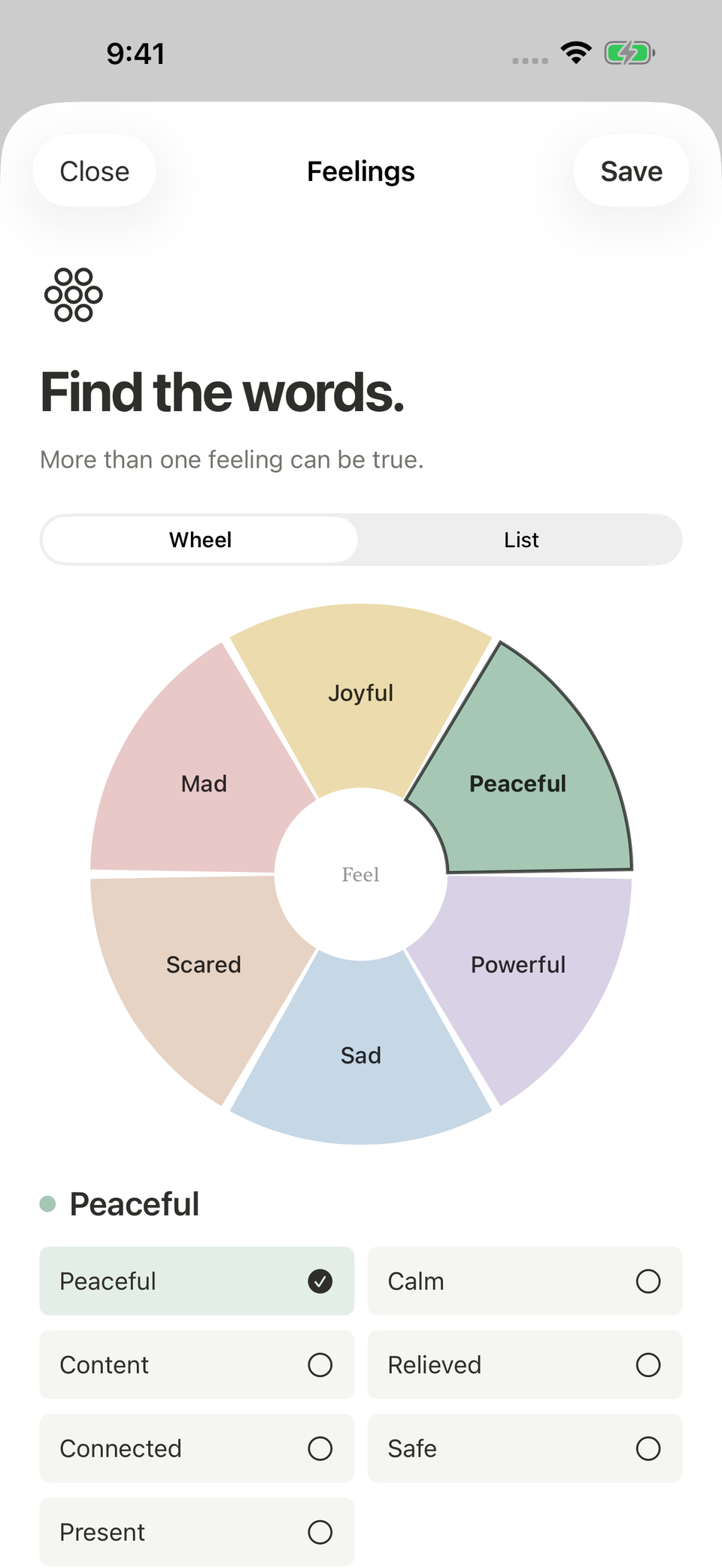
An example Still screen. The demonstration content does not represent a customer's emotional history.
Look for a starting point that leaves the writing yours
A prompt can help when “How do I feel?” seems too broad. It can also be unnecessary when you already know what you want to say. Still offers a blank journal and guided practices including daily reflection, morning writing, evening reflection, gratitude, and circle of control.
Think about which opening you would actually use. After an irritating interruption, a blank page may be easiest: “I was concentrating, and I felt annoyed when…” After a day with no obvious story, a daily reflection question may give you somewhere to begin. A gratitude practice can record appreciation, but it does not oblige you to replace disappointment with something positive.
You can explore the journaling features before making a purchase decision. The prompts are entry points for your words. They are not an assessment of whether your reaction is correct, a clinical interpretation, or an automatic explanation of what another person meant. If those are services you are looking for, a personal journal should not be presented as providing them.
Check how the app handles more than one feeling
A single mood for a day and a specific feeling during an event answer different questions. A broadly good day can contain jealousy, frustration, or a lonely hour. A difficult day can include a moment of affection or relief. An emotion journal is more useful when you do not feel compelled to erase one observation to make room for another.
Still includes daily mood check-ins and a feeling wheel with the option to select several feelings and add context. Its mood views offer seven-day and thirty-day perspectives on the records you enter. These can help you revisit your own descriptions, but they do not prove why an emotion occurred or how much of the day you spent feeling it.
During your evaluation, make a mixed check-in and look at it again. Would you understand what you meant without the details still fresh in your memory? If not, a short note may matter more to you than a chart. If writing a note feels unnecessary, you can leave it out. The right level of detail is the one that serves your reason for keeping the record.
Treat privacy as part of the writing experience
If you expect to write candidly, understand where those words live. Still stores journal and check-in content on your device and does not require a Still account. It also offers an optional app lock using your device's authentication. Read the privacy policy for the full data practices rather than interpreting “private” as a claim that the app makes no network requests.
Purchases, optional usage sharing, and optional feedback have separate documented behavior. Optional usage sharing is off by default. Your choices about those services are different from deciding what to write in an entry. You should not need to send a personal journal page to ask an ordinary support question.
Local storage also means thinking about preservation. Still does not provide account-based cloud sync or an automatic Still server backup. You can save a backup in Files and export readable journal pages. If your most important requirement is having the same journal automatically available across multiple devices, that difference could reasonably lead you to another app.
Pay for the activities you intend to use
For new users, Still Plus unlocks unlimited new journal entries, photo attachments, and guided writing. Check-ins, breathing, and access to existing writing remain available without an active subscription. Existing users keep their original features. The current purchase screen shows the plans, prices, and any trial that Apple determines you are eligible for.
Connect those features to your actual routine. If you want to write about emotional experiences several times a week and sometimes add a photo, the writing features are relevant to your decision. If you primarily want a quick feeling check-in, do not assume that subscribing is necessary for that use.
Also look at the exit. Still's support page explains continued access to reading, editing, deleting, backing up, and exporting existing entries. Understanding what happens if your needs change is part of choosing a journal, especially when the writing may become personally important over time.
Choose the place that lets you be specific
Before you decide, write an entry, save a feeling check-in, and find both again. Notice whether the process leaves room for uncertainty: “disappointed, perhaps also hopeful” is a legitimate observation. You do not need to turn it into a final answer to make the entry worth keeping.
Still may be a good fit if you want those small records alongside longer writing in a local journal. Choose something else if a missing requirement would repeatedly get in your way. A paper notebook, a different digital tool, or a combination can also be a considered choice.
If you want to try Still, view its current App Store listing and begin with one ordinary moment. You are choosing somewhere to keep your own words, not a system that decides what you ought to feel.