“I felt bad” may be true, but it can leave a lot out. Were you worried about what might happen, disappointed by something that had already happened, or annoyed that a small problem kept interrupting you? Writing does not guarantee that the answer will become obvious. It gives you somewhere to try a description and keep the details that make it yours.
That is a practical reason to write down emotions. A feeling word, a situation, and a sentence about what mattered can create a record you would not have if you kept only the label. You can revisit the record, change your wording, or notice that you still do not know. None of those possibilities requires the entry to end with a lesson.
A feeling changes meaning when you add the scene
Consider two hypothetical entries that both begin with “annoyed.” One is about a noisy room while someone is trying to concentrate. The other is about a friend repeatedly arriving late. The word is similar, but the context suggests different concerns: an interrupted task in the first case and an expectation about shared time in the second.
Writing down the scene prevents the emotional label from doing all the work. You might include where you were, what happened just before you noticed the feeling, and which part of the event stayed with you. Describe what you can observe before trying to explain it. “The meeting ended without a decision” is more specific than “Nobody respects my time,” and it leaves the difference between an event and an interpretation visible.
You can still write the interpretation. A journal does not have to sound like a report. The useful distinction is recognizing it as your interpretation: “I took that as a sign that my time did not matter.” That phrasing records the experience without claiming access to everyone else's motives.
The page can hold a first guess and a revision
People do not always arrive at a precise feeling word immediately. You might begin with angry and later decide that disappointed fits better. You might keep both. Having written the first version does not make you inconsistent when you add another description.
A short revision could read: “I called this anger earlier. Now I think I was mostly disappointed because I expected support.” The earlier sentence can remain useful because it shows how you first understood the moment. The later sentence adds context. Neither needs to be declared the only accurate account for all time.
This is one reason to avoid treating a journal as a permanent verdict on a relationship or on yourself. “I felt ignored during that conversation” describes an experience. “I am someone nobody listens to” makes a much larger claim. On the page, you can notice that jump and decide whether you want to keep, qualify, or rewrite it.
More words do not automatically mean more understanding
An entry can become repetitive. You may find yourself writing the same accusation, prediction, or question again without adding anything you want to preserve. Continuing is not a requirement. You can stop, change the subject, or switch to a description of what is around you now.
Length is a poor measure of whether the writing served its purpose. Three sentences may capture an experience accurately. Three pages may be useful when the sequence matters. The difference is not a competition between a quick check-in and “real” journaling; it is a choice about how much room this particular moment needs.
A helpful stopping question is: “Have I written the part I wanted to remember?” That question does not demand relief, a solution, or a more positive mood. It asks whether the record is sufficient for now. If writing is making the experience feel harder to manage, you can put the journal down and choose another form of support or an ordinary activity instead.
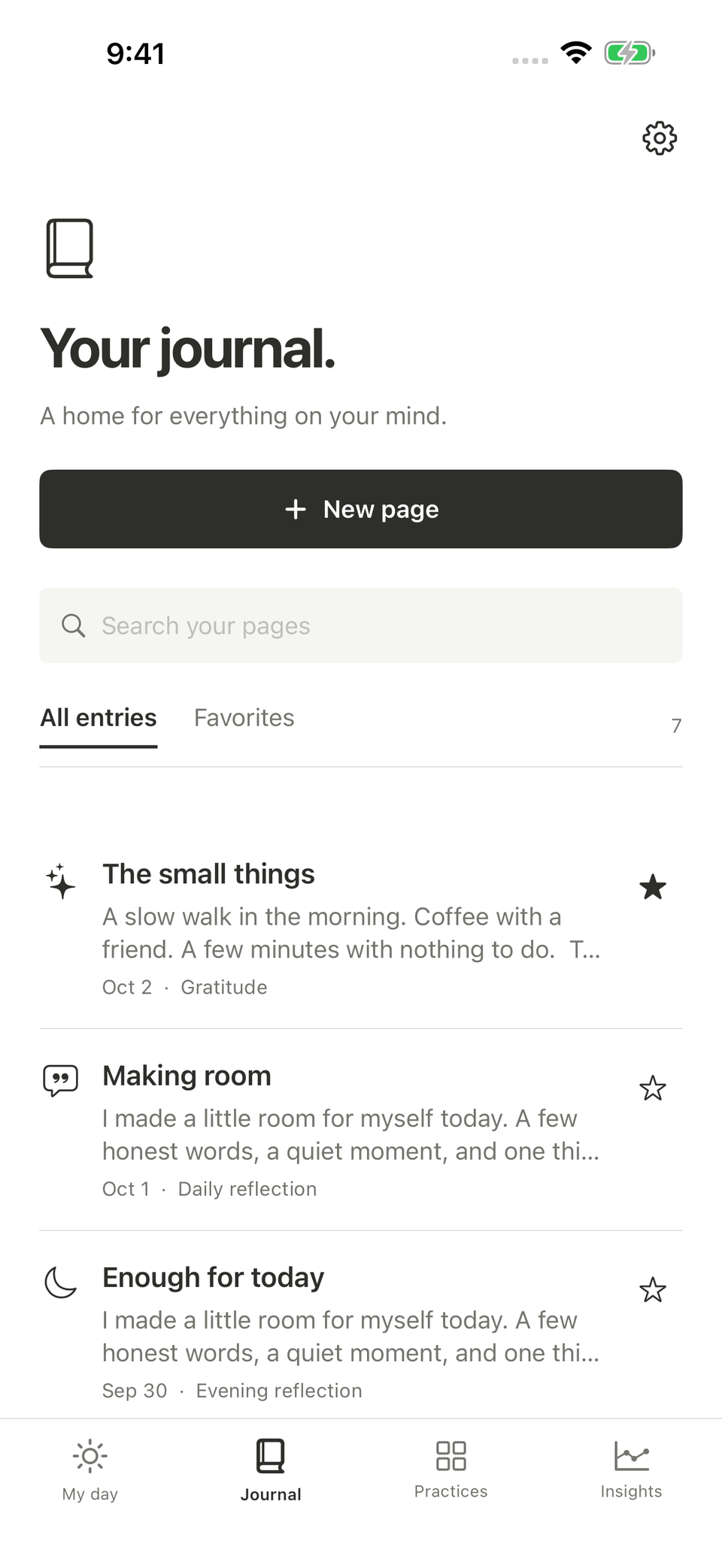
The app screen contains illustrative journal content. Your entry can be much shorter than the example.
What research can tell us, and what it cannot
Researchers have studied several activities that involve words and emotions. They are not all the same as keeping an everyday journal. In one laboratory study of affect labeling, naming emotional material was associated with changes in brain activity while participants viewed negative images. That finding does not establish that a particular journaling app produces a clinical benefit.
Research on structured expressive writing also gives a more complicated picture than “writing always helps.” A meta-analysis of randomized trials found limited or no overall health effects in the outcomes it examined. Different studies use different instructions, populations, and measures. It would be misleading to turn any one result into a promise about what will happen when you open your journal tonight.
You can value a journal for its ordinary functions without making that promise. It can store your description, let you return to an event, and keep your chosen words together. Whether you find those functions useful is a more modest and personal question than whether writing is a treatment.
Try a four-part entry about a manageable moment
Choose something recent that you feel comfortable describing. It could be an interrupted plan, a pleasant exchange, or uncertainty about a decision. There is no need to select the most distressing event you can remember. Use these four parts as suggestions, not a form you have to complete.
First, record the event: “The plan changed this afternoon.” Second, try a feeling word: “I felt disappointed.” Third, add why the moment mattered to you: “I had been looking forward to seeing someone after several quiet days.” Fourth, leave room for another observation: “I also felt relieved that I would not need to rush.”
Now read the entry once. Is there a claim about another person's intention that you cannot know? Is there a broad judgment about yourself that you would rather describe as a thought? You can revise those parts while keeping the emotional experience intact. The goal is a record you recognize, not a sentence that sounds wise.
Keep mixed emotions on the page
An event can matter in more than one way. A new opportunity may bring excitement and worry. A cancelled obligation may bring disappointment and relief. If an entry feels incomplete, adding a second feeling can sometimes describe the situation more faithfully than searching for one perfect word.
Try joining the observations with “and.” For example: “I feel hopeful about the change, and I am worried about what I do not know yet.” That construction allows both statements to remain visible. It does not ask you to decide which feeling deserves to win.
You may also decide that no available word fits. A concrete sentence can be enough: “I keep returning to what was said, but I cannot name the feeling yet.” Writing can preserve uncertainty as well as a clear label. An empty space in your understanding is not a failed entry.
Make the record easy to return to
If you expect to look back, include enough context for your future self. “After the call about Saturday” may be more useful than “after that thing.” A clear opening sentence can help you find the entry later without requiring a complicated filing system.
In Still, you can use a journal page for the longer account or a feeling check-in for a shorter record with context. Choose based on what you want to save. A photo may help recall an ordinary moment, but it is optional; words alone can do the job.
The importance of writing down emotions is not that every feeling must be documented. It is that you have a way to keep the experiences you choose, in language you can revisit. Start with a sentence that is true enough for this moment. You can leave it there, add to it later, or decide that today the page is not what you need.