A mood tracker is useful when you want a quick record of your overall impression of a day. An emotion journal gives you more room to describe a particular experience: what happened, which words fit, and why the moment mattered to you. If both kinds of record would be useful, you do not necessarily have to choose between them. Still includes daily mood check-ins, feeling check-ins, and journal writing in the same app.
The important difference is the question each record answers. “How did today feel overall?” and “What was happening for me after that conversation?” can produce different answers without contradicting each other. Before you choose an app, decide which question you most often wish you had somewhere to answer.
Put the same day through both approaches
Imagine an ordinary Tuesday. You finish a task you had been avoiding, enjoy lunch with a colleague, and discover in the evening that a plan you were looking forward to has changed. You could reasonably describe the day as broadly good while still feeling disappointed about the cancelled plan.
A daily mood record preserves your overall impression. It is compact and easy to compare with other days. It may be exactly what you want if you do not intend to write about every event. The tradeoff is that the reason behind the choice may become less obvious as time passes.
An emotion journal could preserve the evening's smaller story: “I felt disappointed when the plan changed. I had pictured having something to look forward to after work.” That entry does not invalidate the lunch or the finished task. It adds detail about a moment that mattered. The more useful format depends on whether you want a broad marker, the context of an event, or both.
A quick check-in can be enough
There is no obligation to expand every mood into a paragraph. If a short record fits your reason for tracking, making it more elaborate may only add work. A useful app should let you complete the activity you chose without making a longer reflection feel like the price of entry.
For example, someone might check in once after dinner because they want a simple record to revisit at the end of the week. They may occasionally remember a reason without needing to write it down. Another person may prefer a few words of context each time. Neither method is automatically more accurate or more committed.
When evaluating mood-tracking features, check whether you can correct an entry, understand what each choice represents, and look back without confusing a missing record with a neutral day. Also ask whether the record reflects your overall day or a particular moment. Those choices affect how you will interpret it later.
Context matters when the label is not the whole story
An emotion word can carry different meanings in different situations. “Excited” before a trip may involve anticipation and uncertainty. “Excited” after finishing a creative project may involve satisfaction and a wish to share it. The word helps identify something about the experience, but the surrounding sentence makes the record personal.
If that context is why you want an app, prioritize notes and writing over the appearance of a chart. Try recording an event with two feelings, such as disappointment and relief. Then return to the record the following day. Is it clear what you meant, or does the entry need a sentence about the situation?
An emotion journal can also hold an unfinished description. “I thought I was annoyed, but perhaps I felt left out” is a useful observation. You do not have to replace it with one confident label before saving. Look for an approach that gives you room to revise your own wording rather than treating the first selection as a final explanation.
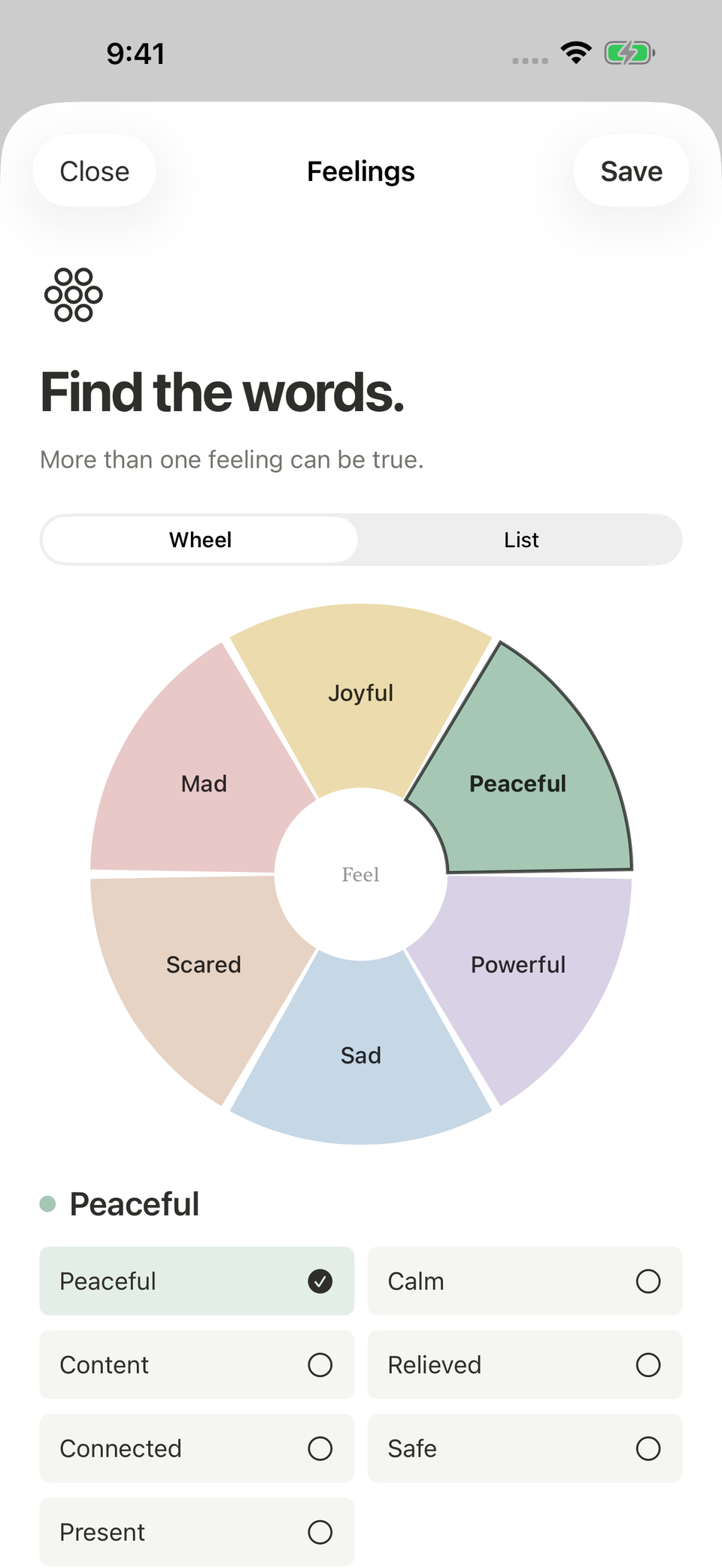
Still's app interface. Example content is illustrative and is not a clinical assessment.
Compare what you will want to read later
Creation is only half of the decision. Think about how you expect to revisit the material. If you want an overview of recent check-ins, a mood view may be convenient. If you want to remember why a conversation stayed with you, a journal entry may answer the question more directly.
Still offers seven-day and thirty-day mood and feeling views. These reflect the records you enter. They do not establish the cause of a feeling, measure every hour of your experience, or tell you how you should have felt. A chart can be a starting point for your own questions, but it is not a substitute for the context you chose to record.
Try a simple retrieval test before settling on an app. Save a mood, make a feeling check-in, and write a short page. Return to each one without following the exact steps you just used to create it. Which kind of record feels easiest to understand? Which answers the question you had in mind when you began looking for a tool?
Decide whether one app will simplify your routine
Keeping everything in one place can reduce the need to decide where a particular reflection belongs. Still lets you start with a mood, a feeling word, or a journal page. If your preferred form of reflection changes across the week, that flexibility may be useful.
Separate tools can also make sense. You might enjoy handwriting longer entries and use your phone only for brief check-ins. You might already have a journal archive you do not want to move. Combining activities is a benefit only if it serves your routine; it is not a reason to abandon a method that already works for you.
Be careful about expecting automatic connections that a product has not documented. Having mood and journal features in the same app does not mean it analyzes your writing, identifies triggers, or proves a relationship between events and emotions. Evaluate the actual actions available to you, not an inference suggested by the presence of two features beside each other.
Look at paid access before making a record you depend on
The difference between mood tracking and journal writing also matters when you consider a subscription. For new Still users, Still Plus unlocks unlimited new journal entries, photo attachments, and guided writing. Check-ins and breathing remain available without an active subscription, alongside access to existing writing.
That means a person mainly seeking brief check-ins has a different purchase decision from someone who wants to write new pages regularly. You can review the support information and the current Apple purchase screen to understand what applies to you. Do not assume a trial is available until Apple confirms eligibility.
Think about preservation as well as access. Still stores journal and check-in content locally, without account-based cloud sync or an automatic Still server backup. If you want an ongoing record, learn the backup process. Readable journal exports and an app backup serve different purposes, and separate feeling notes are not the same as journal pages in an export.
Use a one-week comparison without scoring yourself
If you are uncertain, try a small comparison. On a day when you want a quick record, make a mood check-in. When a particular event needs more room, record a feeling and some context or write a page. Leave a day blank if you do not want to document it. The exercise is about choosing a format, not maintaining a streak.
At the end, ask three practical questions. Which record did you actually want to create? Which was useful to revisit? What did you wish it had captured that it did not? You may find that a simple mood entry covers most days and a longer emotion journal is useful occasionally. You may discover that you mainly want writing and rarely need an overview.
If both approaches belong in your routine, explore Still as one way to keep them together. If only one matters, let that guide your choice. The goal is a record that serves your curiosity about your own experiences, with no requirement to make every day fit the same format.