The email says there will be a meeting tomorrow. It does not say much else. By evening, you have imagined several versions of the conversation, and none has actually happened. “Anxious,” “worried,” and “concerned” might all seem to fit.
These words overlap. In ordinary writing, anxious often describes apprehension or unease; worried can highlight the thoughts circling a possible problem; concerned can express that something matters and deserves attention. They are useful distinctions to try, not a fixed scale from mild to severe.
A journal can hold the feeling while making the uncertainty visible. You can record what the email actually said, what you are imagining, and what remains unknown. The goal is not to talk yourself into a cheerful prediction. It is to keep your present account clear about the difference between information and possibility.
Anxious can describe the experience of uncertainty
The APA describes anxiety in terms of apprehension and anticipated threat, often with a focus on what may happen. In everyday life, you might use anxious for the uneasy experience before a result, a conversation, or an unfamiliar task.
You do not need a perfectly identified cause to use the word. An entry might say, “I feel anxious about tomorrow, but I cannot tell which part is bothering me most.” That is a clearer description than inventing a reason simply because the page seems to demand one.
The word also does not diagnose an anxiety disorder. A feeling label is a description you choose in a moment. Clinical questions involve more than selecting a word, including how experiences persist and affect daily life. If anxiety is ongoing or interfering with your life, professional support can be more appropriate than relying on a journal to explain or address it.
Worried often points toward a particular possibility
In ordinary usage, worried can emphasize what you keep thinking might go wrong. You may be worried that a message sounded abrupt, that an application was incomplete, or that a journey will be delayed. Writing the possibility as a sentence can reveal what the broad label contains.
For the meeting email, the sentence might be: “I am worried that I will be asked to explain work I have not finished.” That tells you more than “Tomorrow will be awful.” It names a prediction and the part of the situation connected to it, while leaving open whether the prediction is accurate.
Worry can also move between subjects. If your page starts with the meeting and ends with several unrelated possibilities, you can choose to record one of them rather than trace every branch. A personal entry is allowed to be selective. Completing an exhaustive list is not a requirement for honest writing.
Concerned can describe care and attention
Concerned often means that you see a possible problem or care about an outcome. “I am concerned that the new timetable leaves too little travel time” can introduce a practical issue. “I am concerned about my friend” can express care without specifying exactly what the friend is feeling.
Some people use concerned because it sounds calmer than worried. Others use it for something very serious. The word alone cannot tell a reader how urgent the situation is. If urgency matters in your record, describe the circumstances rather than expecting the label to carry all of that information.
You can be concerned without knowing what action is needed. For example: “I am concerned about the change in plans, and I want to understand what it means before deciding.” The entry preserves attention and uncertainty together. It does not require you to resolve the issue in the same sitting.
Use the word that makes the sentence more accurate
Try placing each word into a sentence about the same event: “I feel anxious before the meeting.” “I am worried I will be unprepared.” “I am concerned that the agenda is unclear.” Each version points to a slightly different aspect of the situation.
You may want all three. You may find that none fits as well as “nervous,” “hesitant,” or your own phrase. A vocabulary tool is useful when it gives you possibilities to consider, not when it turns a private account into a multiple-choice exam.
The labels do not need to be ranked. Choosing concerned does not mean you are handling the situation better than someone who chooses anxious. Choosing worried does not prove that the worry is proportionate or disproportionate. The surrounding description does much of the work that the single word cannot.
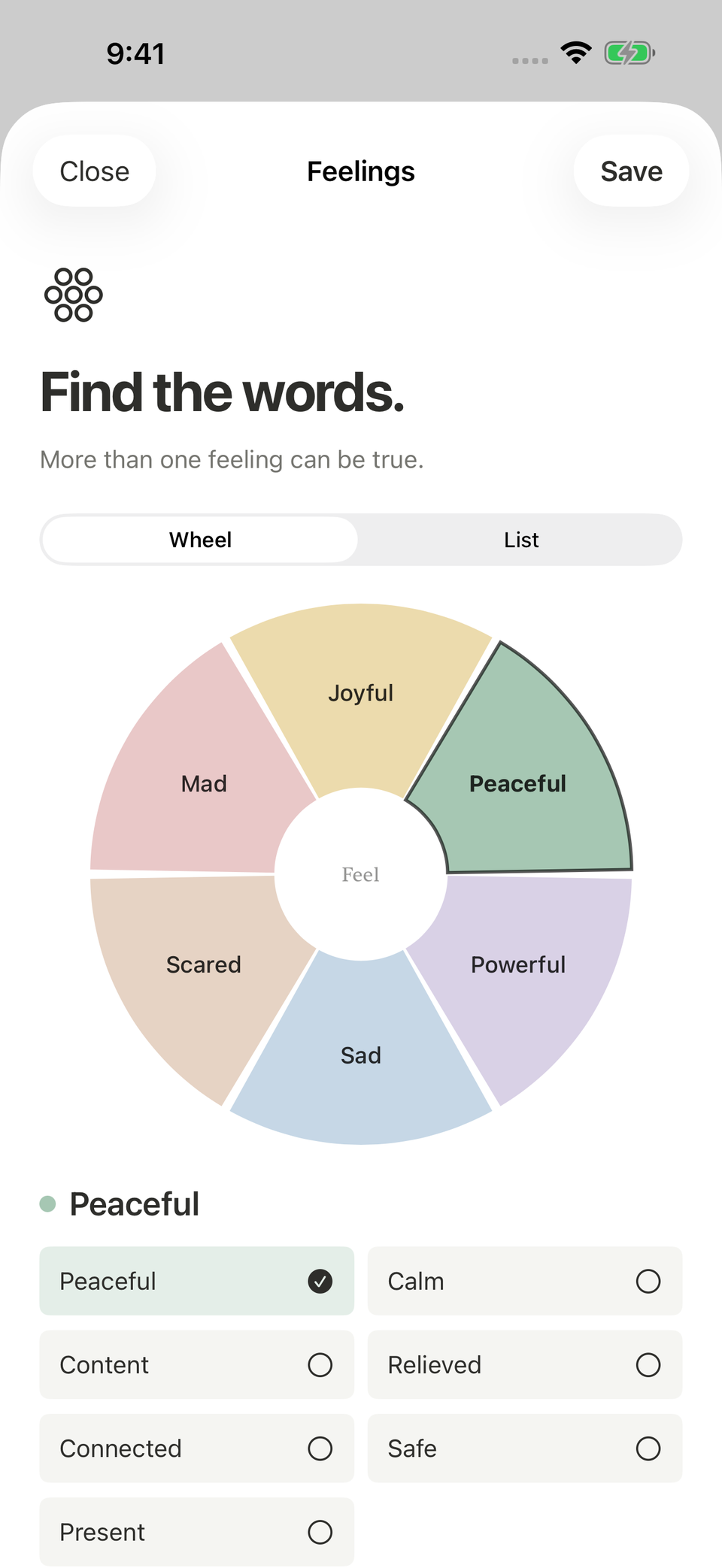
An illustrative Still screen. A chosen feeling word describes a personal check-in; it does not determine a diagnosis or predict an outcome.
Write the known part before the imagined part
For an optional exercise, begin with what you could point to in the situation. In the meeting example, that might be: “The invitation is for tomorrow morning. It includes my manager and two colleagues. There is no agenda attached.” These are details from the hypothetical invitation.
Then give the prediction its own sentence: “I am imagining that I will be questioned about the unfinished project.” The phrase “I am imagining” is useful because it marks the status of the thought. You can take the concern seriously without presenting the imagined conversation as something already confirmed.
A third sentence can preserve the gap: “I do not yet know why the meeting was called.” You do not have to fill that gap with either reassurance or the worst possibility. If there is a practical question you want to ask, record it separately: “I could ask whether there is anything to prepare.”
Try a different example: concern for another person
Suppose a friend has been quieter than usual. You feel worried and want to write about it. An entry could begin, “We have exchanged fewer messages this week, and I miss our usual conversations.” That describes the change you have noticed and part of your own response.
You might then add, “I am concerned that something is difficult for them, but I do not know what their week has been like.” This leaves their experience with them. It avoids treating your concern as evidence that you already understand their situation.
If you decide to contact the friend, the journal does not need to become a script for obtaining reassurance or an explanation. You can simply record your intention: “I want to ask how they are.” The other person's answer may add context later, and the earlier page can remain an honest record of what you knew before that conversation.
Let an entry end while the question is still open
There may be no new information by the time you finish writing. That does not mean the entry failed. You have recorded the situation, your chosen feeling word, and the uncertainty. A closing line such as “I will know more after the meeting” can mark where today's account ends.
If writing turns into repeatedly rehearsing the same feared outcome, you can stop or choose a different activity. You are not obliged to keep going until the emotion changes. Journaling is one possible form of reflection, not a test of persistence or a substitute for needed care.
The APA's discussion of anxiety disorders distinguishes occasional worry from persistent difficulties that interfere with life. A saved entry can describe what you are experiencing, but the app cannot make that clinical distinction for you.
Keep the record in your own language
In Still, you can begin with a feeling check-in and use the journal if you want more space. A single sentence may be enough: “Worried about being unprepared; the agenda is still unknown.” Another time, you may want to keep the full sequence of your thoughts.
Anxious, worried, and concerned are not competing verdicts. They are neighboring words that can help you describe apprehension, a particular possibility, or care about an outcome. The most useful entry is the one that makes clear what you mean today, including what you do not yet know.