You are waiting for news, and there is nothing useful left to refresh. “Scared” fits part of it. So does “helpless.” Those words can describe different aspects of the same moment: fear about what may happen, and a sense that you cannot change it.
You do not need to choose the most sophisticated label before you can write. Scared and frightened overlap considerably in ordinary English. Helpless adds a question about influence or available action. A journal can hold all three, along with the circumstances that make them meaningful to you.
This guide uses everyday examples to explore those words. It is an invitation to describe an experience, not a test of whether your reaction is reasonable or a way to determine whether a situation is safe. If you need immediate practical help, attending to that need comes before making a journal entry.
Scared and frightened do not need a strict dividing line
Both scared and frightened usually express fear. Someone might say they were scared before a difficult appointment and frightened by a sudden noise. Another person would comfortably swap those words. Neither choice gives an outsider a reliable measurement of how intense the experience was.
You may have a personal distinction. Perhaps “frightened” feels sharper to you, while “scared” is a word you use more easily in conversation. That distinction can be useful in your own writing without becoming a universal rule. A feeling vocabulary offers possible words; it does not require everyone to organize their experience identically.
The APA's emotion words checklist groups scared and frightened with other fear words. It is a useful reminder that these labels can be neighbors rather than separate boxes. In a journal, “I was frightened when the lights went out” already communicates something clear. You do not need to replace it because a different word appears elsewhere on a wheel.
Helpless describes a problem of influence
Helplessness involves the sense that you cannot do much to change an unwanted situation. The APA Dictionary's definition emphasizes perceived powerlessness or incapacity. That makes the word useful when the painful part is not only what might happen, but also the absence of an action that seems available to you.
Think of a train stopped between stations while an important event begins without you. You may know the delay is temporary and still feel helpless about missing the beginning. You have a clear wish and very little influence over the train's movement. The entry does not need to exaggerate the event for the feeling to make sense.
Feeling helpless does not establish that absolutely no action exists. Nor does it mean you have overlooked an obvious solution. Sometimes the limits are real. A careful entry leaves room for both possibilities: “I cannot change this part,” and “I am not sure yet whether there is anything else I can do.”
Separate the event from the part that frightened you
Suppose you are preparing to speak at a community meeting. The event is a five-minute introduction. The frightening possibility might be forgetting what you planned to say, being judged, or being unable to answer a question. Those are different concerns, even though each could be summarized as “I am scared of the meeting.”
A more specific entry might read: “The introduction is tomorrow. I am scared that I will lose my place and everyone will notice. I have written my opening, but I keep imagining the moment after I go blank.” This is a hypothetical example, not a prediction of what will happen. It preserves the particular concern you are having now.
You can then name what remains uncertain without trying to cancel the feeling: “I do not know how the room will respond.” The page does not have to conclude that the meeting will go brilliantly. Its job can be much smaller: to keep a feared possibility from becoming indistinguishable, in the record, from an event that has already happened.
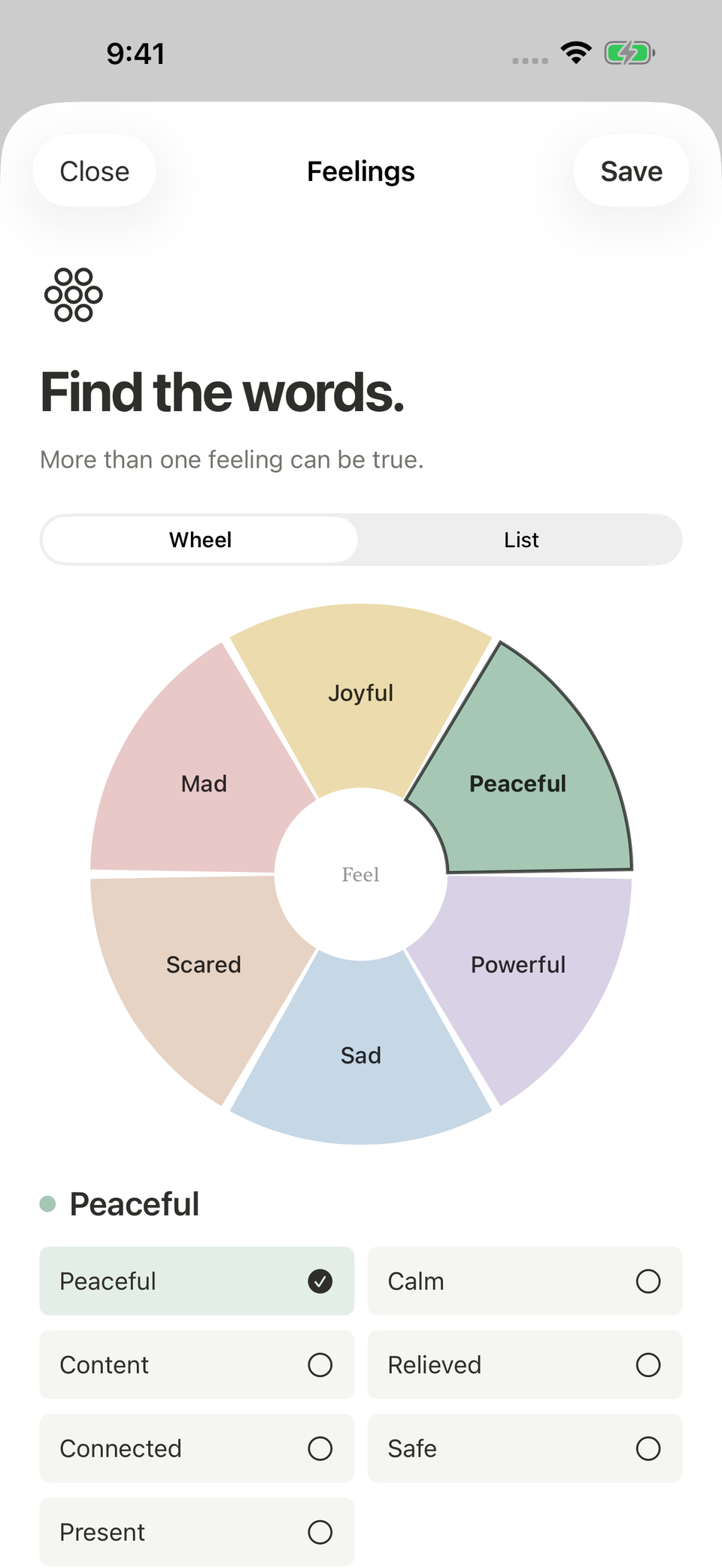
An illustrative Still screen. The useful word is the one you can connect to your own description; the selection is not an assessment.
Write about the limit without turning it into an identity
There is a difference between “I could not change the decision” and “I am helpless.” The first locates a limit in an event. The second can sound like a conclusion about your whole self, even when you only meant one difficult afternoon.
Consider waiting for an organization to respond to an application. You have submitted the requested material. The review belongs to someone else. “I feel helpless about the waiting because there is no further information I can provide today” describes that arrangement more precisely than “I cannot do anything.”
The precise version may still feel uncomfortable. Writing is not a requirement to discover control where none exists. It can simply show which part is outside your influence and which part remains your own choice, such as whether to keep checking your inbox or return to another activity. Neither option needs to become a lesson about how well you cope.
Try a short account with four separate lines
If you want a little structure, write one line about the situation, one about the feared outcome, one about the limit, and one about what you need now. You can stop after any line. Leave out details that you do not want to revisit.
For the delayed train, a hypothetical entry could be: “The train has stopped, and I do not know when it will move. I am scared I will miss the performance I promised to attend. I cannot make the train leave, and that feels helpless. I want to send a brief message and then wait for an update.”
Notice what this entry does not settle. It does not say whether the performance will be missed, whether the recipient will be upset, or whether sending the message will make the writer feel better. It records what the writer knows, fears, cannot control, and wants to do. That is enough material for a useful account.
Let the feeling change without correcting the earlier page
Later, the train moves or the meeting ends. You might feel relieved, disappointed, embarrassed, or still frightened. A later outcome does not make the earlier feeling false. You were describing your experience with the information you had then.
If you return to the entry, consider adding a dated sentence rather than rewriting the whole event from the ending. “I arrived during the interval” tells you what happened next. “It turned out fine, so there was no reason to be scared” removes the uncertainty that was central to the original moment.
The same care applies when the outcome is difficult. An earlier fear is not proof that you caused or predicted what happened. The journal is a record of your perspective, with its changing knowledge and limits. Keeping that perspective visible can make a later reread less confusing.
A feeling word can be the beginning or the whole entry
In Still, a feeling check-in can be a small place to start. If you want more room, the journal lets you describe the event in your own language. You do not have to use both every time, and a brief note does not become incomplete merely because it lacks a resolution.
You might finish with “Scared about tomorrow; helpless about the waiting.” On another day, you may want a longer account with several uncertainties and a practical question. The length should follow what you want to preserve, rather than an obligation to work through everything in one sitting.
Scared, frightened, and helpless are words you can try, keep, or change. They help most when they remain attached to a particular experience. The aim is not to prove which label wins. It is to leave yourself a description that still makes sense when the moment has passed.