Fear is connected with a sense of threat: something feels capable of harming you or something that matters to you. Sometimes the threat is immediate and identifiable. Sometimes everyday language stretches “afraid” to include what you imagine might happen later. A journal can give you room to describe that distinction, but it cannot determine whether a situation is safe simply because you have written about it.
If you choose to write, start with the part you can name. “I am afraid of being judged when I speak” is different from “I heard a sudden noise and felt frightened.” Both descriptions may be honest. They point to different experiences, and neither requires you to prove that your reaction was the correct size before recording it.
What fearful describes, and what it does not
Fearful describes the experience of fear. It is not a fixed personality, a measure of courage, or evidence that the feared outcome will happen. You can feel fearful in one situation and capable in another. You can also act deliberately while still noticing fear.
Psychology makes distinctions that ordinary conversation sometimes blurs. The APA Dictionary's discussion of anxiety contrasts a more immediate, specific threat response with apprehension directed toward possible future danger. These are useful distinctions for describing an experience; they are not a test you need to pass before choosing a feeling word.
On a journal page, you can be more specific than the label alone. Are you responding to something happening now, something you remember, or something you expect? You may not be certain. Writing “I cannot tell whether I am reacting to this situation or remembering an earlier one” preserves that uncertainty without pretending to resolve it.
Separate the event from the outcome you imagine
Suppose you have been asked to present an idea to a group. The event you know about is the invitation and the upcoming presentation. A feared outcome might be losing your place, being challenged, or having people think the idea is unprepared. Those possibilities are not the same as things that have already occurred.
A journal entry could use three short headings: “What I know,” “What I am imagining,” and “What matters to me.” Under the first, you might write that the presentation is on Thursday and lasts ten minutes. Under the second, you might name the thought that you will forget an important point. Under the third, you might write that you care about explaining the work clearly.
The exercise does not require you to replace the feared outcome with a reassuring prediction. “Everyone will like it” is also something you cannot know. The useful result is a clearer record of the difference between the known event, the possibility you are considering, and why it matters.
Fear can sit beside another feeling
Being fearful does not mean the entire experience is unwelcome. A person might look forward to a new opportunity and worry about the responsibility. They might want to have an honest conversation and feel nervous about the response. One feeling does not cancel the other.
If the entry sounds incomplete, try a second sentence beginning with “I also…” For example: “I am afraid I will not explain myself clearly. I also feel hopeful about finally discussing this.” You can stop after those two statements. You do not need to decide which one is the truer feeling.
Be careful about turning mixed emotions into a verdict about what you should do. Feeling afraid does not automatically mean you should avoid an activity, and feeling excited does not establish that it is wise or safe. A journal records your experience. Practical decisions may require information, support, or considerations beyond what the emotion itself can tell you.
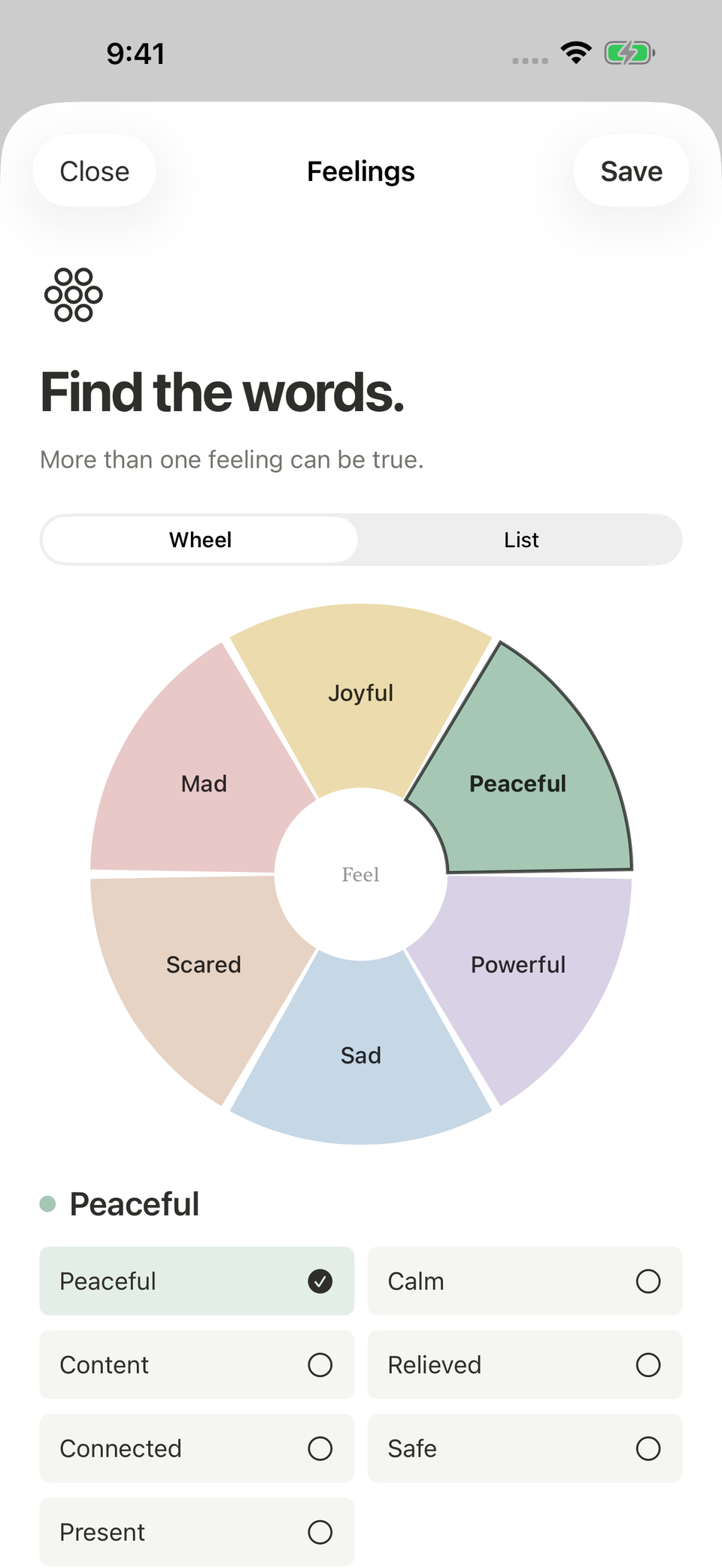
An illustrative Still screen. Choosing a feeling word is a reflection activity, not a diagnosis or a safety assessment.
Write about a manageable example first
You do not have to begin with the strongest fear you have experienced. A smaller moment may be enough to learn what kind of writing you find useful. Consider waiting for feedback on a piece of work, attending an unfamiliar gathering, or asking a question when you do not know how it will be received.
One hypothetical entry might read: “I have not received an answer yet. I keep imagining that the silence means the work was not good. I do not actually know the reason for the delay. I care about this because I spent time on it and want it to be understood.” The entry makes room for the feeling while showing where interpretation begins.
Notice what this example does not do. It does not declare the fear irrational, demand a positive ending, or try to settle another person's opinion. It records a particular concern in enough detail that the writer can recognize it later. Your own entry may use a completely different tone or stop after the first sentence.
Keep a boundary around the writing
A journal exercise is optional. You can choose how much detail to include and whether to continue. If a description is becoming more distressing than useful, there is no requirement to finish the story, reconstruct every detail, or keep writing until you feel differently.
You can make the boundary concrete before you begin. “I will describe the concern in three sentences” is one option. “I will write what is happening now, without revisiting the whole history” is another. The point is to give yourself a choice about the task, rather than treating the page as an instruction to disclose everything.
If there is an immediate safety concern, practical safety steps take priority over a writing exercise. If fear is persistent, overwhelming, or interfering with everyday life, support from a qualified professional may be more appropriate than asking a journal to handle the problem alone. That is a limit of the tool, not a failure to journal correctly.
Read the entry for language, not a grade
When you return to a fearful entry, you may notice that some of the feared possibilities did not happen. You may also find that an experience was difficult in a way you did not anticipate. Avoid using either outcome to criticize your earlier self for having a feeling.
Instead, look at the description. Did you record what you knew at the time? Did you distinguish a possibility from a fact? Is there something you would add now? A later note can preserve new information without erasing the earlier experience. For example: “The conversation was awkward at first, and we understood each other better by the end.”
You can also leave the entry alone. Not every record needs a follow-up, an insight, or an action plan. Its purpose may have been to hold the words you chose on that day. That is a sufficient reason to keep it.
Give the feeling room without asking it to explain everything
If you use Still, a feeling check-in can hold a short description, while a journal page gives you more space for the event and the possibilities surrounding it. Choose the format according to what you want to save, not according to how serious you think the feeling ought to look.
A useful starting sentence is: “The thing that feels at stake is…” You might write about belonging, competence, an important relationship, or uncertainty you cannot yet reduce to one concern. You do not have to reach the bottom of the feeling in one sitting.
Fear can be part of an honest account without becoming the whole account. Write what you can describe, keep unknowns visible, and let the entry remain a record of a moment rather than a permanent statement about who you are.