“Disappointed that we rushed the goodbye.” That can be a complete journal entry. It names a feeling and the part of the day you want to remember. You do not need to add a lesson, a plan, or a description of the weather to make it count.
If this is the kind of writing you want to keep, test a journal with a sentence instead of a long sample page. The right tool should make that small account easy to save and recognizable when you return. A product designed around elaborate daily sessions may be more structure than you want.
Still has both feeling check-ins and journal pages, which give you different places for a brief account. The choice between them depends on whether you mainly want to name a moment or build a longer writing record. Here is how to evaluate that difference without turning a one-sentence habit into a large project.
Decide what the sentence needs to preserve
A very short entry has limited room, so it helps to know its job. You might want to preserve a specific feeling, the event connected to it, or a question you would otherwise forget. These purposes can overlap, but they do not require the same amount of detail.
“Thankful” records a label. “Thankful that Sam remembered the date” records the label and a reason it mattered. “Why did being remembered mean so much today?” leaves a question. Any of these may be the right entry for you, depending on what you want from a later reread.
When trying an app, use a sentence you would realistically write at the end of a tiring day. Avoid an unusually polished sample that hides the ordinary constraints. You are testing whether the smallest useful version of your routine fits, not demonstrating how much the editor can hold.
Compare a check-in with a journal page
A feeling check-in starts with a label and can include a short note. That can suit a quick account such as “Annoyed by the interruption during lunch.” You may appreciate having the word as a starting point instead of needing to open a blank page first.
A journal page gives more room to develop an account. Even if you begin with one sentence, you may want to add context later, keep several related observations together, or create a readable document from your writing. Those are reasons to consider the journal rather than treating all brief records as interchangeable.
Still's mood page and journaling page describe the two experiences. One practical distinction is preservation: readable journal exports do not include separate feeling notes. If you expect your short accounts to become a collection of exported writing, choose where to put them with that requirement in mind.
Test the whole small action
The meaningful test includes opening the app, getting to the right place, entering the sentence, saving it, and finding it again. A beautiful editor is only one part of that path. You may care more about whether the saved account ends up where you expect.
Try the sequence once with a made-up entry, then leave the app and return. Can you recognize the saved record? Is its date clear? If you notice a typo or want to add a few words, can you do so without turning it into a new entry by mistake? These are practical questions you can answer directly.
Do not assign a speed score from one attempt or assume every device will behave the same. Notice the friction that matters to you: an unclear control, an unnecessary choice, or a format you dislike. A short-entry journal succeeds when its ordinary path is comfortable enough that you would choose to repeat it.
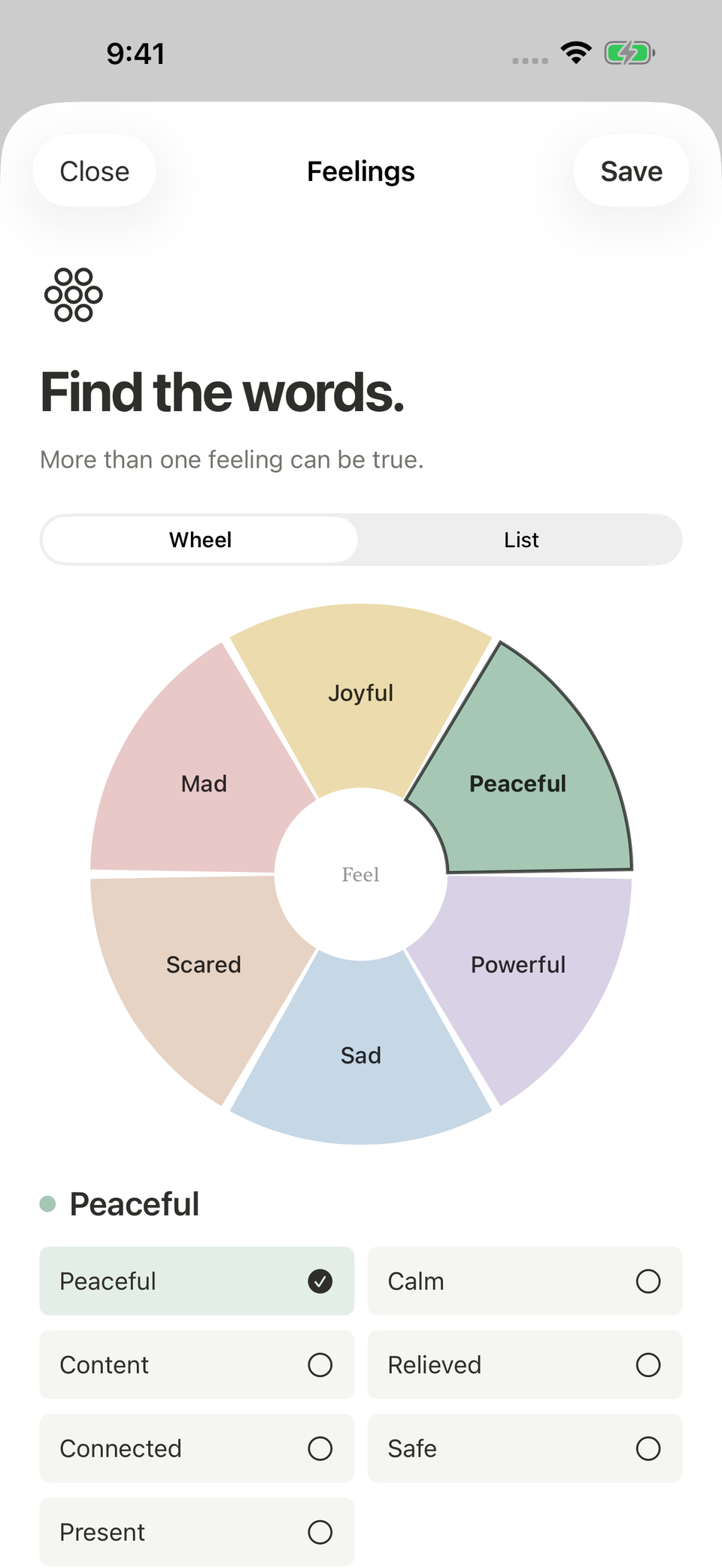
An illustrative Still screen. A feeling label and a brief note can be enough when you want to preserve one moment.
Add just enough context to recognize the moment
Short does not have to mean vague. “Bad day” may be exactly what you want to save, but it can be hard to interpret later. One concrete detail can make the sentence more useful without making it substantially longer.
Compare “Felt ignored” with “Felt ignored when my suggestion was skipped in the planning call.” The second still records a perspective rather than proving anyone's intention. It gives your future self a scene to connect with the feeling. That may be all the context the entry needs.
You can also narrow an overbroad sentence. “Everyone was impatient” might become “I felt rushed while answering the last question.” The revision brings the account back to an experience you can describe directly. You do not need to perform this editing exercise every time; it is simply one way to use a few words carefully.
Leave room for a sentence to grow
Some short entries stay short. Others become the beginning of a longer account once you have time or find a clearer description. Look for a format that allows both without requiring you to decide the final length at the start.
For example, you might save “Proud that I asked for more time.” Later, you may want to add what made the request difficult or how the conversation unfolded. If the extra detail belongs with the original moment, editing a journal page may be more useful than scattering it across unrelated records.
Still lets you edit existing journal entries. If you want to distinguish the first account from a later addition, you can label that addition with your own date or wording. Do not assume the app supplies a full revision history; keep the distinction within the text when preserving it matters to you.
Avoid buying a routine you do not want
A product may offer photographs, prompts, detailed reviews, or many ways to organize writing. Those features can be useful, but a person who wants one sentence a few times a week may not need all of them. Start with your smallest real use before evaluating the larger feature set.
For new users, Still Plus unlocks unlimited new entries, photo attachments, and guided writing. Feeling check-ins and breathing remain available without an active subscription, along with documented access to existing journal entries. The support page explains current access, including retained features for existing users.
If check-ins meet your needs, that is a valid outcome of the evaluation. If you want many journal pages because their writing and export format suits you, the paid features may be relevant. The decision should come from where you want your sentences to live, not from the idea that a subscription makes a small habit more serious.
Think about what a month of short entries will look like
One sentence is easy to remember today. Thirty separate sentences create a different retrieval problem. Consider whether you will recognize them by date, wording, or the event described, and whether you want to review them at all.
A few well-chosen words can help: the lunch interruption, the bus ride home, the conversation after class. You do not need an elaborate naming system. What matters is that the detail makes sense to you and does not require more maintenance than the writing itself.
Missing days also belong in this decision. If you will only write when something stands out, the record will be selective. That is acceptable for a personal journal. It should not later be mistaken for a complete account of how you felt every day, especially when you are comparing one period with another.
Choose a small entry because it fits the moment
A one-sentence journal is not a promise that every emotion can be resolved in a sentence. It is a way to keep something you might otherwise leave unrecorded. You can stop there, return later, or choose a different form of support when writing is not what you need.
Look at Still on the App Store if you want to try feeling check-ins alongside flexible journal pages. Use an ordinary sentence as your test, and follow it through saving and retrieval. If the smallest entry works well, you have evidence about the part of the app you are most likely to use.