A feeling wheel is most useful when it helps you move from a vague description toward words that fit your experience. Its value is not the number of labels it can put on a screen. When choosing an app, check whether you can read the words, understand the choices, keep more than one feeling when needed, and save enough context to make the record meaningful later.
Still includes a feeling wheel alongside mood check-ins and journal writing. We make the app, and this guide explains how to evaluate that kind of tool, including reasons it may not be what you need. You can use a feeling vocabulary as a starting point without treating it as an authority on what you really feel.
Begin with a situation you can describe in your own words
Before comparing interfaces, choose an ordinary example. Perhaps a plan changed and you felt “off.” Perhaps a conversation went better than expected, leaving you both hopeful and uncertain. You do not need a difficult or deeply private event to test whether a tool makes sense.
Write a short description before opening the wheel. “I wanted the plan to happen, and I am irritated that I rearranged my afternoon” gives you something to compare with the available words. You might decide that disappointed and annoyed both fit. You might prefer your original sentence to any label.
This small step keeps the vocabulary in a supporting role. If you begin by trying to fit yourself into the first appealing word on the screen, you may lose the detail you wanted to record. A useful app should leave room for your wording and for the possibility that the list does not contain an exact match.
Readability matters more than a complicated diagram
A wheel can show relationships between broad and more specific labels, but visual richness is not automatically practical on a phone. During an evaluation, look at the words you would actually select. Can you read them comfortably? Can you distinguish neighboring terms? Does the interaction work at the text size and screen size you use?
Different feeling wheels organize words differently. Some include states, attitudes, or self-evaluations alongside emotions. A grouping is a way to explore vocabulary, not proof that every word belongs to one scientifically settled category. If a word feels misplaced to you, you do not have to adopt the diagram's interpretation as your own.
Also check the app's current version rather than relying on a screenshot from an older review or a feature promised for the future. Interfaces can change. What matters for your decision is whether the version you can install lets you complete a check-in in a way you understand.
Look for room to keep more than one word
A mixed experience is a good test of a feeling-wheel app. Imagine being pleased that a friend has a new opportunity while also feeling sad that you will see them less. One label may not capture what you want to remember. Being allowed to record several feelings gives you a different kind of record from being forced to select a single final answer.
Still lets you select several feelings and add a note. That can be useful when the first word is only part of the story. The note might say, “I am happy for them and disappointed that our routine will change.” The record can hold both observations without resolving the tension between them.
Do not assume that a multi-select feature interprets the combination for you. Recording hopeful and worried does not generate a reliable explanation of the event or tell you which feeling should guide a decision. The value is that your own description can stay more complete.
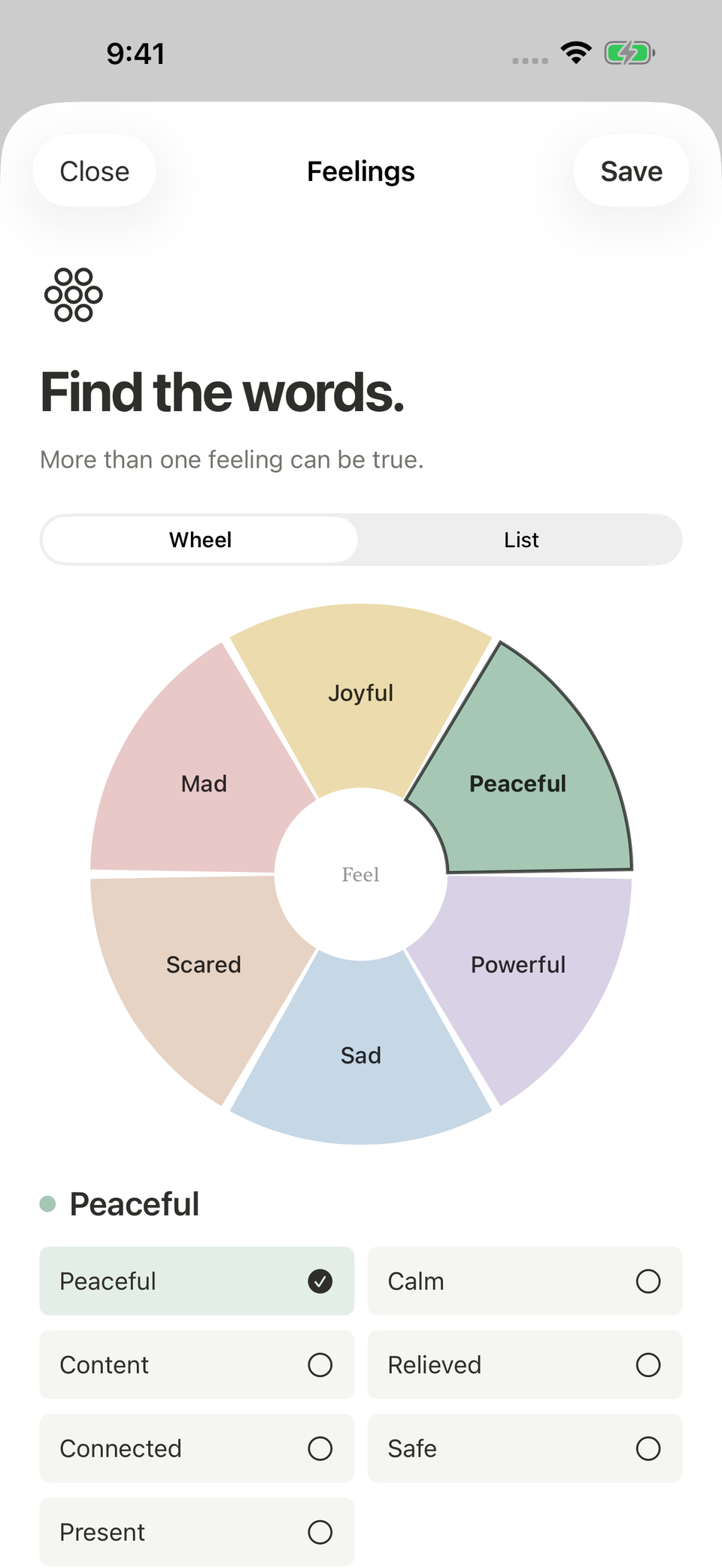
An illustrative app screenshot. Check the current installed version for its available vocabulary and controls.
Test the note beside the label
The same word may appear in many entries while meaning something different each time. You could feel disappointed by a delayed project, a cancelled visit, or an experience that did not match your expectations. A short note preserves the distinction when the event is no longer fresh.
Try adding one sentence that answers “What happened just before I noticed this?” Then consider a second sentence about what mattered to you. Avoid making the note an investigation of someone else's intentions. “I expected a reply today” records an expectation. “They deliberately wanted me to worry” is a different kind of claim and may not be something you know.
When comparing apps, ask whether notes are easy to save and revisit. A beautiful vocabulary list with no useful record may suit someone who only wants a word in the moment. If you want an emotional journal, the saved context is part of the feature you are choosing.
Make sure revision is an ordinary action
You may choose a word and later decide that another one fits better. That does not make the first check-in dishonest. You were using the language available to you at the time. An app should make it clear how to edit or delete your own record when you want to.
Test this before building a long history. Save a check-in about something ordinary, return to it, and find the editing controls. Decide whether you understand what will change and what will remain. If a record is duplicated instead of updated, that may affect how you interpret the history, so pay attention to the app's actual behavior.
Still's support page explains the available check-in controls. Its daily mood record and more detailed feeling activity have different roles, so read the instructions for the feature you are using. The important point is having control over your own descriptions, rather than treating an accidental selection as something permanent.
Understand what the overview is showing
A feeling history can invite useful questions, such as “What was happening around the entries where I wrote disappointed?” But a chart reflects the entries you made. It cannot fill in every unrecorded moment or establish that one event caused a particular feeling.
Still provides seven-day and thirty-day views for looking back at mood and feeling patterns. Use those views alongside the context you saved. A repeated label might reflect a recurring situation, a word you happen to prefer, or the moments you were most likely to record. The chart alone does not distinguish those explanations.
If a product describes its records with clinical language, look carefully at what is actually being measured and what evidence supports the claim. A tool for self-description should not quietly become a diagnostic authority just because it presents the entries in a polished visualization.
Choose the wheel as part of the whole writing routine
You may want only a quick way to find a word. Or you may want that word to lead into a longer page. Still combines feeling check-ins with journal writing, which can suit someone who moves between those two activities. You can use the short record when it is enough and write more when the context deserves space.
Consider storage and access as well. Still keeps journal and check-in content locally, without a Still account or automatic account-based cloud sync. Check-ins remain available without an active Still Plus subscription. Read the current privacy and support information before deciding that those choices fit your needs.
A useful final test is simple: can you record the ordinary situation you chose at the beginning, find it later, and recognize what you meant? If yes, the vocabulary and the app are serving your purpose. If not, keep looking—or use a sentence in a notebook. The words are there to help you describe your experience, not to replace it.