A gratitude journal can give you somewhere to record what you appreciate. If you also want to write honestly about disappointment, anger, or a complicated relationship, choose a format that lets those feelings remain on the page. You should be able to describe a kind gesture without having to call the whole day good.
That is the main product question: do you want a dedicated gratitude ritual, or a flexible emotional journal that can include gratitude? A narrowly focused format may suit you if a short appreciation list is exactly what you want. Still is worth considering when you want open writing, optional guidance, and feeling check-ins alongside the things you are thankful for.
We make Still, so this is a guide to assessing its fit, not an independent ranking of gratitude apps. The examples below are hypothetical ways to test a journal before you make it part of your routine.
Test the format with an honestly mixed day
Imagine that a friend helps you move, but the move itself is unwanted. You appreciate the friend and feel sad about leaving. A journal that only asks for three good things can capture the help. It may take a little more freedom to preserve what the departure means to you.
Try writing: “I am thankful that Maya stayed until the last box was packed. I am still disappointed that I had to leave the apartment.” These sentences do not cancel each other. They concern different parts of the event, and a useful format should allow you to keep both without treating the second as a failure of the exercise.
During your evaluation, look at how easily you can add that second sentence. Can you continue in ordinary prose? Can you skip a prompt that does not fit? If you want a separate place for difficult feelings, is moving between the two areas comfortable? A pleasant opening screen tells you less than this small writing test.
Decide whether you want a list, a story, or both
A list is useful when you want a compact record: a meal someone made, a thoughtful message, a quiet hour. You may not want to explain each item. In that case, a simple, repeatable list can be a good match rather than an inferior version of long-form journaling.
A story serves a different purpose. “My brother called” names an event; a paragraph can preserve why the call mattered. Perhaps he remembered something you thought he had forgotten, or listened without interrupting. If those details are the reason you want to write, make sure the app gives you room for them.
Still's journal pages offer that room. You can keep a short entry or develop a longer one, and guided writing is available through Still Plus for new users. The relevant question is not whether you can produce a beautifully finished page. It is whether the format lets the important detail survive.
Look at the language a prompt asks you to use
Prompts shape the starting point of an entry. “What did you appreciate?” leaves room for a specific answer. A prompt that asks how a difficult experience made you better introduces an interpretation you may not share, especially while the event is still unresolved.
When comparing journals, read several prompts rather than judging the entire experience from one appealing example. Notice whether you can ignore, adapt, or leave a question unanswered. You may enjoy a consistent gratitude practice while still wanting control over the conclusions your writing reaches.
You can also bring your own question into a blank page. For example: “What did someone do that I want to remember accurately?” This invites a concrete account without requiring a positive assessment of everything around it. If you already have questions you like, access to an open editor may matter more than a large prompt collection.
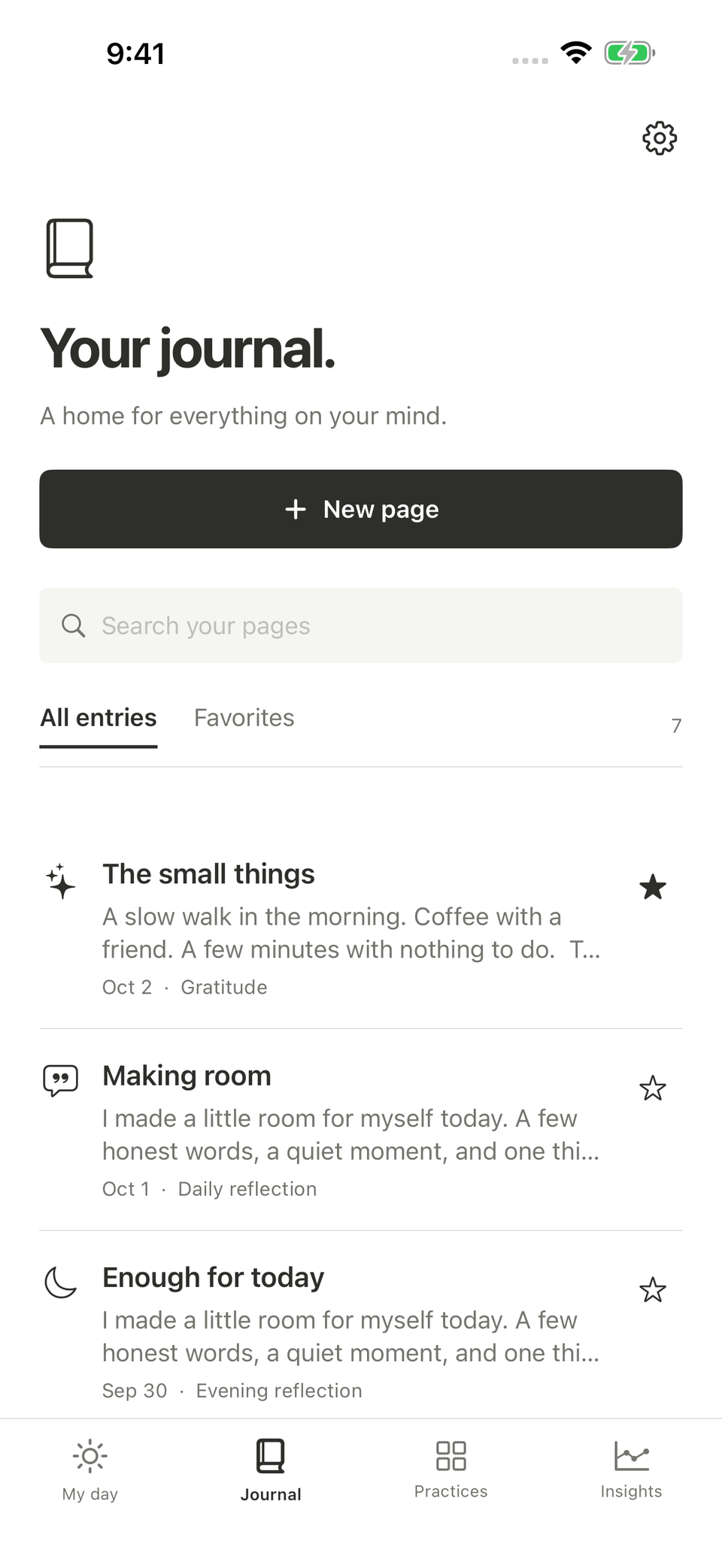
An illustrative Still journal screen. An entry can include appreciation and a difficult feeling in the same account.
Keep appreciation separate from obligation
Some entries involve help that came with a complicated cost. You may appreciate a favor and dislike a comment that accompanied it. You may love someone and feel angry about how they treated you. A journal should give you space to describe that combination without deciding what you owe the other person.
A hypothetical entry might say: “I appreciated the ride home. I felt uncomfortable when the conversation became personal, and I did not know how to change the subject.” That is more informative than forcing the whole interaction into either a grateful or an ungrateful category.
This is also a useful privacy test. Would you feel comfortable writing that sentence in the app you are considering? Think about device access, account arrangements, and where any exported copy would go. The freedom to keep an honest private account can matter more than decorative features when a gratitude entry concerns an important relationship.
Decide what a photograph adds
A picture can preserve something you appreciated: a note left on the table, a shared place, or a small project someone helped you finish. It can also omit the emotional context entirely. A photograph of dinner will not necessarily remind you, months later, that someone cooked because you had a difficult day.
If photos matter to your practice, test a picture with a short explanation rather than a picture alone. Write what you want your future self to notice. You might decide that the words carry everything important and the image is unnecessary; that is useful information before choosing a paid feature.
Photo attachments are part of Still Plus for new users. Evaluate them as a way to preserve relevant context, not as a requirement for an attractive gratitude journal. Check the current support information and purchase screen for the access that applies to you, including any features retained by existing users.
Choose how you want to reread the record
What would make a gratitude archive worthwhile to you? You might want to find a particular memory, notice the ordinary kinds of help you value, or simply keep a record without reviewing it regularly. Those goals suggest different retrieval needs.
Try making three ordinary entries, then looking for one without relying on a perfect memory of its wording. Consider whether dates and entry titles give you enough orientation. A title such as “The last box” may work for you; “What I appreciated about the move” may be easier to recognize later. Use the naming style you would actually maintain.
Avoid treating the archive as a scorecard for how grateful you have been. A gap tells you that no entry was saved there; it does not explain your attitude during that time. If an app's review experience encourages conclusions you do not find useful, include that in your decision about whether the format suits you.
Understand what you can keep if your routine changes
You may enjoy a focused gratitude practice for a month and later want broader emotional writing. Or you may stop writing regularly while still caring about the pages already made. Look at both the current writing experience and the future access arrangements.
Still retains access to existing entries without an active subscription, including the documented reading, editing, deletion, backup, and export controls. Journal exports and app backups have different purposes; the backup guide explains preservation. Still does not provide account-based cloud sync, so consider whether deliberate backups fit your habits.
These details are relevant even to a small collection. A short description of someone's kindness may matter more to you than dozens of longer entries. It is reasonable to test how you will keep that description before making the app its only home.
Choose the kind of honesty you want to practice
A dedicated gratitude app may be right if you want a narrow, repeatable place to list appreciation and prefer to write about other feelings elsewhere. A flexible journal may fit better if you do not want to divide a single experience across tools.
Consider Still if you want gratitude to sit within a wider emotional record: a feeling check-in on some days, a few sentences on others, and a photo or guided page when it is useful. See the current App Store listing with that specific use in mind.
Your writing does not have to choose between appreciating something and admitting what was hard. A suitable journal lets you preserve both accurately, in the amount of detail you want, without requiring the day to end with a positive verdict.