If your days change shape, choose an emotion journal that offers more than one way to make a record. Some evenings you may want to write a page. On others, a feeling word and a sentence may be the amount you want to save. A tool that fits only your most organized day can become another thing you feel behind on.
Still offers journal writing and feeling check-ins in the same app, so you can choose the size of the activity. That flexibility may suit an irregular routine, but it is only one part of the decision. You also need to understand how the app handles gaps, whether you want reminders, and what makes a saved entry easy to return to after time away.
Describe the routine you have before designing a new one
It can be tempting to evaluate a journal against an imagined schedule: ten quiet minutes every evening, a clear mind, and a phone with no interruptions. If that is not how your week usually works, the evaluation may tell you little about whether you will want to use the app.
Write down two or three realistic circumstances instead. You might have a minute between activities, a longer stretch on a day off, and an evening when you are too tired to reflect. These are not problems the journal must eliminate. They are conditions the product needs to fit.
For each circumstance, ask what you would actually want to keep. In the short gap, perhaps “rushed after the delayed train” is enough. On the quieter day, you might want to write about why a conversation stayed with you. On the tired evening, the right choice may be making no entry at all.
Test the smallest record you would still find useful
A short check-in can contain real information. “Overwhelmed by the number of decisions today” says more than an empty marker that an activity was completed. You do not need to expand it into a paragraph if the sentence captures what you wanted to remember.
Try a small record in the app before exploring every feature. Can you find the feeling you want, add context if you choose, and save without extra setup? Does the record still make sense when you return later? The purpose of this test is to see whether the smallest activity is useful on its own.
Still's feeling features let you name feelings and add a note. You can use that shorter format alongside a daily mood check-in or a longer journal page, according to the activity you want. Do not treat a quick entry as a lesser version of an elaborate reflection; they can serve different purposes.
Make sure a longer page remains available
An irregular routine does not mean you always want minimal writing. A particular experience may need room even if you have not journaled for several days. The useful flexibility is being able to choose more space when you want it, rather than committing to the same entry length every time.
Imagine a week with little time to yourself, followed by a quiet morning. You may want to describe a sequence of events: what you felt during a difficult exchange, what you understood afterward, and what remains uncertain. A journal page can hold that account in your own order.
When evaluating an app, try both ends of the range. Save a short check-in and a longer page. Notice whether you understand how to find each one again. In Still, journal writing provides the fuller writing space, with guided starting points available through Still Plus for new users.
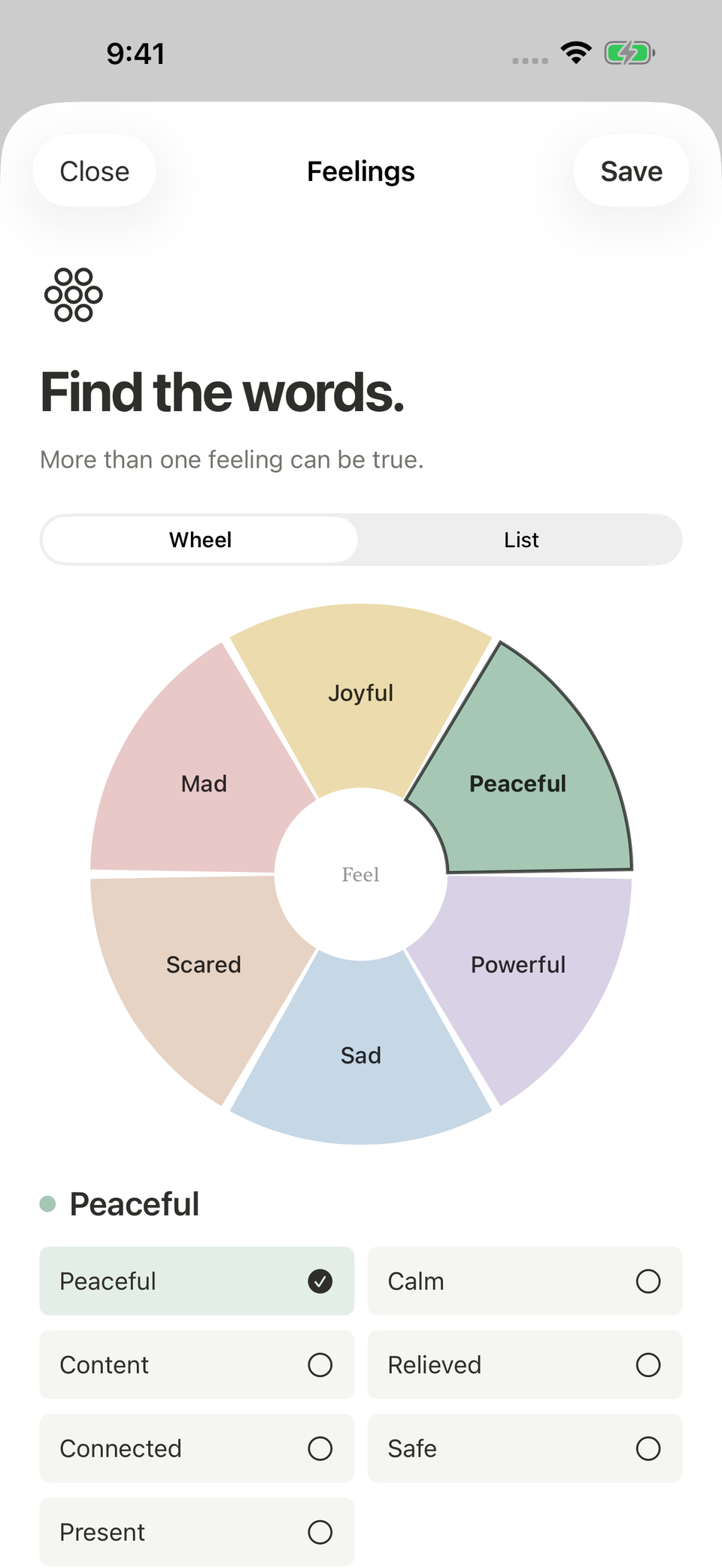
An illustrative app screen. A short check-in and a longer journal entry can serve different needs on different days.
Decide what a gap should mean
A missing entry should not be turned into a story about your commitment. You may have been occupied, content without wanting to document it, away from the phone, or uninterested in reflecting at that moment. The blank record does not tell you which explanation applies.
Look at how the app displays unrecorded days. Can you distinguish a gap from an actual mood choice? Does the history remain understandable when there are only a few entries in a week? A display that assumes a complete daily record may be less useful if occasional writing is the routine you intend.
You can also decide not to reconstruct the gap. “I did not write last week” is enough context if you need it. If you remember something you want to preserve, describe it as a recollection rather than pretending you recorded every moment at the time. Your journal does not have to become a backfilling project before you are allowed to begin again.
Use reminders only if the invitation is welcome
A reminder can be useful when it arrives at a time you would like to write. It can also be poorly matched to a schedule that changes often. Before turning one on, consider whether a fixed daily invitation would help you remember the activity or simply arrive when you cannot use it.
Check the current app's reminder controls and your device notification settings rather than assuming that any notification will be delivered exactly when you imagine. The relevant choice is whether you want the invitation. You can keep a journal without one.
An alternative is to connect writing with an event that occurs more reliably than a clock time: after you arrive home, when you finish a particular routine, or when you notice a moment you want to keep. This is a personal way to organize the activity, not a promise that linking it to an event will create a permanent habit.
Compare paid features with the use you expect, including quieter weeks
Subscriptions are easiest to evaluate when you think about ordinary variation. If you expect several written entries some weeks and very few during others, ask whether the available plan still makes sense for that pattern. You do not have to promise yourself daily use to justify enjoying a feature, but you should understand what you are buying.
For new users, Still Plus unlocks unlimited new journal entries, photo attachments, and guided writing. Check-ins, breathing, and access to existing writing remain available without an active subscription. Existing users retain their original features. Check the current Apple purchase screen for prices and any trial eligibility rather than relying on a fixed price quoted in a blog.
The support page also explains the controls that remain available for existing entries. Knowing that you can return to, edit, delete, back up, or export your saved writing helps you evaluate the journal as a record rather than only an activity you perform while a plan is active.
Try returning after a deliberate break
One revealing app test is to stop using it briefly and then return. You do not need to create an artificial perfect week. Leave the app alone when you do not feel like writing, then open it with one specific moment in mind.
Can you begin without first dealing with a backlog? Can you find the earlier record without remembering the exact screen you used? Does the interface make it clear where to start now? These questions matter to someone whose routine includes gaps, even if they are less visible in a feature list.
Still stores your journal and check-in content locally, so preservation remains a separate consideration when you return after a longer interval or change phones. Learn the backup process if you intend to keep the record over time. A flexible writing routine still benefits from knowing how your saved material is retained.
Choose room for variation
The right emotion journal for an irregular routine is one whose useful version is available on an ordinary, imperfect day. That might mean a quick feeling record, an occasional longer page, or a combination. It need not mean turning every spare minute into reflection.
If those options are what you want, explore Still's current app and test them with your actual circumstances. Include a tired day and a gap in the evaluation, not only the evening when you are eager to begin.
You are choosing a place to keep the experiences you decide to record. A changing schedule can shape that choice without becoming a problem the journal must grade, correct, or turn into a streak.