Choose a guided journal if a specific question makes it easier to begin. Choose a blank page if the question feels like an interruption to something you already want to say. If your answer changes with the day, look for a journal that lets you move between the two without treating one as the more complete form of reflection.
Still includes free writing and guided practices. For new users, guided writing is part of Still Plus, alongside unlimited new entries and photo attachments. This guide looks at the choice from the point of view of emotional writing: what happens when you have a feeling to record but do not yet know how you want to approach it?
Try both formats with the same moment
Imagine you spent an afternoon on a task and then learned that the requirements had changed. You feel frustrated, perhaps disappointed, and unsure how much energy you want to spend describing it. There are several reasonable ways to begin.
On a blank page, your opening might be: “I am annoyed that I did the work before anyone told me the plan had changed.” That sentence uses your own emphasis. You can follow the part that matters to you, move into a different feeling, or stop after explaining the event.
A guided opening might ask what took up space in your mind or what was within your control. Those questions could lead to a different entry: “I could not control the change, but I wish I had asked for confirmation before spending the afternoon on it.” Neither version is automatically more insightful. They emphasize different parts of the same experience.
Notice whether a prompt opens the page or narrows it
A useful prompt gives you a manageable starting point. It may help turn a broad question such as “How am I?” into something you can answer, such as “Which moment am I still thinking about?” That can be convenient when you are unsure where to begin.
A prompt can also be a poor match for the moment. If you want to write about disappointment and the question asks only for what went well, you may feel pushed toward an entry you did not intend to make. You can skip the prompt, rewrite it in your own words, or choose a blank page. There is no obligation to complete a question because it appears in an app.
During an evaluation, pay attention to that freedom. Can you follow the prompt briefly and then move on? Can you write a different amount from the example? The presence of guided content is less useful if the structure makes your own experience feel like an inconvenient answer.
Give free writing a small boundary if it needs one
An empty page is not always as unstructured as it looks. You can supply your own boundary: one event, three sentences, or a description of what you would like to remember. That can make free writing more approachable without turning it into a fixed questionnaire.
For the changed-task example, you might choose three sentences. The first describes the event. The second names frustration. The third says what mattered: “I wanted the effort to count, and I felt as though I had to start again.” That is a complete entry if it captures what you wanted to keep.
The boundary can also help when writing becomes repetitive. You do not have to continue describing the same frustration until you produce an explanation or feel differently. Saving a short account and returning to your day is an available choice. The journal should serve the writing you want to do, rather than create another obligation.
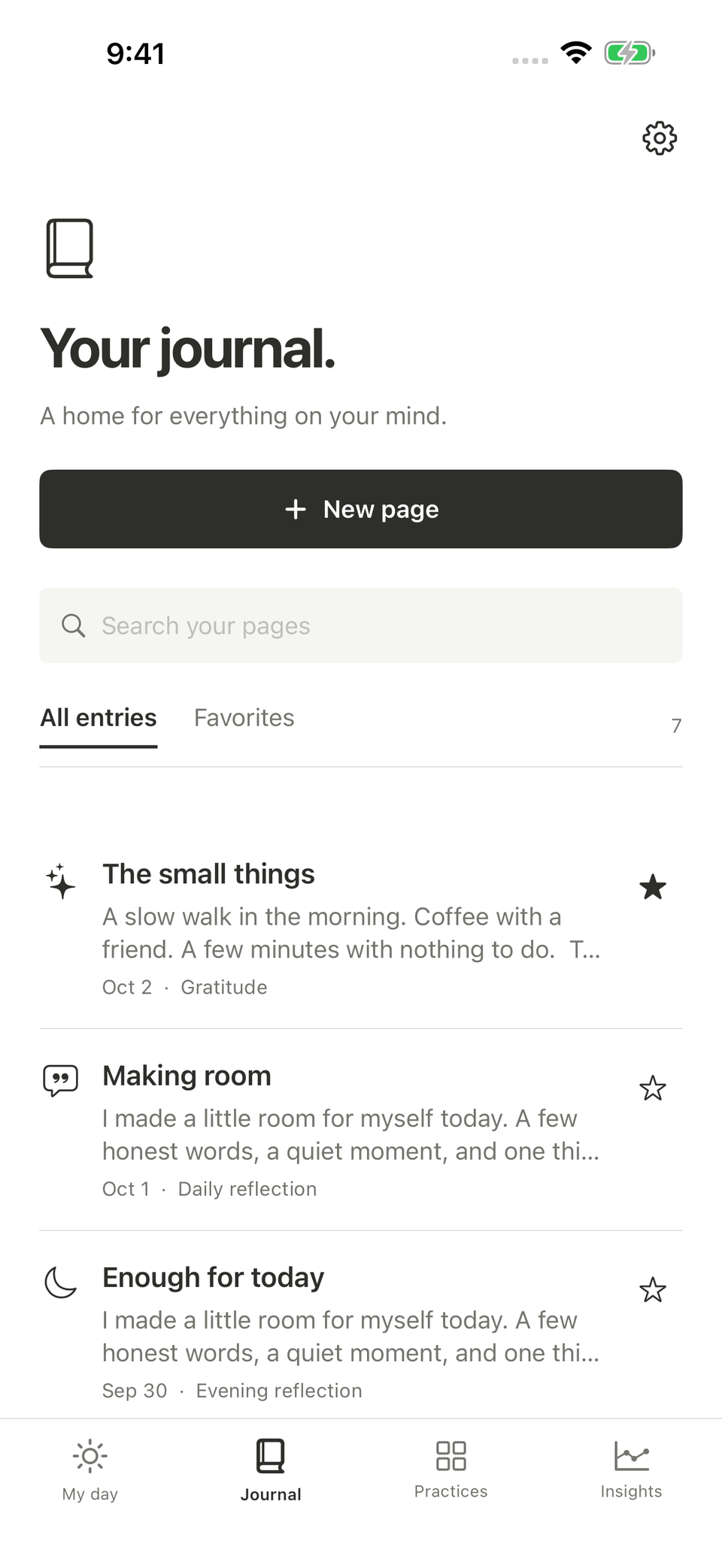
The writing space in Still. Demonstration content is illustrative; the length and wording of your entry are yours to choose.
Match the prompt to the kind of reflection you want
Still's guided practices include daily reflection, morning writing, evening reflection, gratitude, and circle of control. You can read about them on the journaling page. These are different starting points, not a progression you must complete in order.
A morning page might help you record what you are carrying into the day. An evening reflection might give you somewhere to describe a moment after it has passed. A gratitude entry can preserve appreciation without requiring you to deny something that was difficult. Circle of control can be a way to distinguish what you can influence from what you cannot, while leaving the feeling itself intact.
Avoid choosing a practice only because its name sounds like what a productive person would do. The useful question is whether the actual prompt helps you say something you wanted to say. If a blank page does that more directly, the guided option can remain unused.
Check whether the app permits a change of direction
Emotional writing does not always stay with the first topic. You might begin with frustration about a task and notice that the disappointment is connected to wanting your effort recognized. You might start a thankful entry and realize that you also feel sad about how rarely that kind of moment happens.
A journal app should give you room to record that change in your own words. You do not need a special interpretation feature to write, “There is another part of this.” What matters is whether the editor remains a usable place for the entry you are actually making.
Try changing direction during your evaluation. Add a second paragraph that does not answer the original prompt neatly. Then save and reread it. Does the page still make sense as your record, or does the presentation make it look as though you left an assignment unfinished? That difference can tell you a great deal about whether the product's structure suits you.
Understand what a guided journal does not provide
A question is not an assessment. Answering a prompt does not establish why you feel something, whether your interpretation is correct, or what another person intended. Guided writing can organize a page, but the meaning of your answer remains something you may continue to consider.
If you are looking for treatment, professional advice, or support with a difficult mental health concern, a personal journaling app should not be presented as a replacement. You can use a journal alongside appropriate support, but that is a different decision from purchasing a prompt library or a writing interface.
Similarly, you should not expect every guided session to end with a positive statement. An honest entry may finish with “I am still disappointed” or “I do not know what I want to do.” That can be a faithful record of the moment, even if it would not make a tidy example in a product demonstration.
Compare the subscription with the features you will use
If guided writing is the main reason you are considering Still Plus, try to identify the practices you expect to return to. You do not need to use all of them for the product to fit. You also do not need to subscribe merely because having more starting points sounds better in the abstract.
For new users, Still Plus unlocks guided writing, unlimited new entries, and photo attachments. Check-ins, breathing, and access to existing writing remain available without an active subscription. Existing users retain their original features. Check the support page and your current Apple purchase screen for the details that apply to you.
Preservation matters in either format. A guided entry contains your own writing, just as a blank-page entry does. Still stores journal content locally without account-based cloud sync, so learn how to save a backup or export readable pages if you plan to keep a long-term record.
Choose the opening that leaves you wanting to write
Try a prompt and a blank page on different ordinary days. Notice which one helped you begin, which one let you stop comfortably, and which result you wanted to revisit. You may find a clear preference, or you may want both options available.
If that flexibility matters, view Still on the App Store and explore the current features. Begin with a feeling you can describe without pushing yourself toward a difficult subject. The starting sentence can come from a prompt or from you. The rest of the entry belongs to you either way.