A photograph can show the table, the street, or the view. It may not show that you felt relieved to be there, lonely despite the crowd, or thankful for a small gesture just outside the frame. A photo journal becomes useful when it keeps your account of the moment beside the image, without expecting the picture to explain the feeling on its own.
If that is what you want, choose an app by testing the relationship between the photo and the writing. Can you add the context you care about? Can you find it later? Do you understand what happens to both parts when you back up, export, or stop subscribing? Still supports photo attachments in journal entries through Still Plus for new users. The questions below can help you decide whether that approach fits your memories.
Decide what the photograph is doing in the entry
A photo might be the subject of an entry, a reminder of the setting, or a small detail you do not want to forget. Those are different uses. If you want to describe a conversation during a walk, the photograph of the path may help you recall where you were. It does not have to contain the people involved or become a literal illustration of every sentence.
Consider a hypothetical picture of two cups on a kitchen table. The visual record is simple. The emotional context might be that a friend made time to visit after several cancelled plans. An entry could say, “I felt thankful that we finally sat down together. Nothing especially dramatic happened; having the time was the part I want to remember.”
When evaluating a photo journal, try that ordinary kind of entry. If the app encourages elaborate presentation before you can save a few words, decide whether that work is something you enjoy. A photo journal does not need to become a scrapbook project unless making the page is part of the experience you want.
Let the words complicate the picture
A pleasant-looking image can come from a difficult day. A grey street can be the setting for a moment of contentment. Treating the image as evidence of the emotion can flatten the memory into a story it did not actually have.
You can make the difference explicit. “The photograph looks cheerful, but I felt lonely at this point in the evening” is a legitimate entry. So is “I expected to feel disappointed by the rain, and instead I enjoyed having an excuse to slow down.” Your writing can preserve a contrast that the image would not communicate to someone viewing it later.
This is a reason to look for a genuine writing space rather than only a caption field designed for display. You may want one sentence, or you may need a paragraph that changes direction as you describe the moment. The useful feature is room for your account, including the parts that do not match the appearance of the photograph.
Try one entry before moving a whole photo history
It is tempting to begin by collecting every image you might someday journal about. A smaller evaluation tells you more about daily use. Choose one photo you are comfortable keeping in a journal and write the context while it is still reasonably fresh.
In Still, photo attachments belong with journal entries. Start by checking the current journaling features and the purchase options available to you. Then test whether attaching the image, adding the writing, and returning to the page feel manageable. Do not assume that a journaling app will automatically import or organize an entire photo library unless that is an explicitly documented feature.
A useful evaluation question is, “Would I want to make another entry like this next week?” If the answer depends on spending an hour arranging pictures, that might suit an occasional memory project rather than the everyday emotional journal you originally wanted. Both uses are valid, but they call for different expectations.
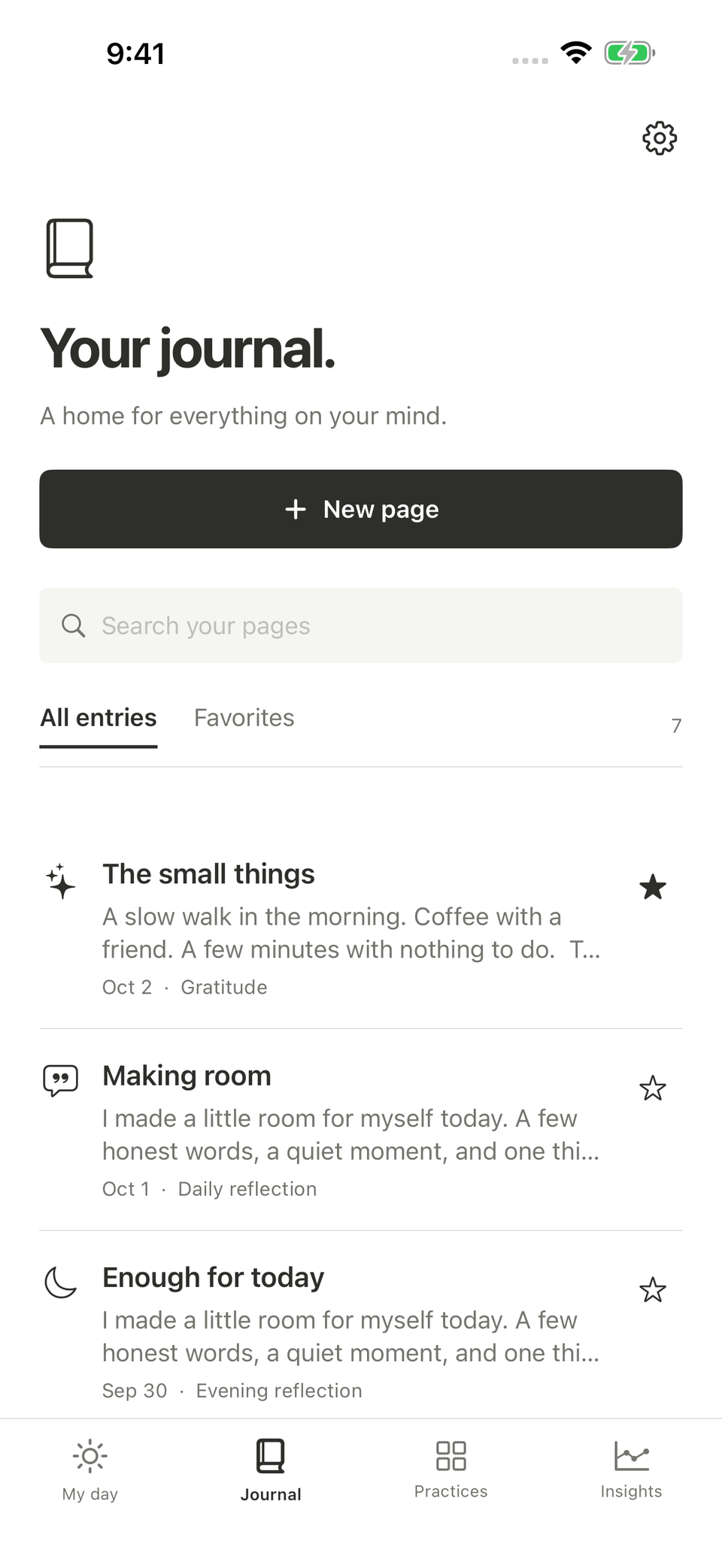
The Still writing interface. Photo availability for new users depends on Still Plus; check the current in-app plan details.
Choose what the image does not need to reveal
A private journal can contain photographs of people, locations, or documents as well as words. Before attaching an image, consider whether the detail you want to remember requires all of the information visible in it. You might describe the meaningful part in writing instead of saving an identifying picture.
For example, an entry about feeling proud after completing a task may not need an image containing a client's name or a private message. A photograph of the workspace or a simple written description may preserve what matters to you. The decision is about the content of the record, not a requirement to make every journal page anonymous.
If you later share an entry, review the image as carefully as the text. A photo may reveal something you did not mention in the paragraph. Keeping the original journal private and creating a separate message can be a useful way to choose what you actually want another person to see.
Check the storage and preservation choices
Still keeps journal content on your device and does not require a Still account. It does not provide account-based cloud sync or an automatic Still server backup. If photos are part of the record you want to preserve, learn the backup process before the collection becomes important to you.
A backup and a readable export have different jobs. The backup is intended for restoring supported Still data. A readable export is a document you can open outside the app. Inspect the result of a small export so you understand how your selected writing and images are represented in the format you choose. Do not assume every format carries visual material in the same way.
Read the backup guide and support information for the current controls and limits. Also consider the destination you choose in Files. A copy stored with another provider has its own access and privacy arrangements; the journal's app lock does not automatically protect every exported copy.
Make retrieval part of the buying decision
A photo entry is only useful as an archive if you can recognize it later. An opening sentence that names the event may help more than a vague title such as “Today.” You do not need a complicated classification system, but include the detail your future self is likely to remember.
For instance, “The visit after the cancelled weekends” may bring back the kitchen-table moment more readily than “A nice afternoon.” You can include both the concrete event and the feeling in the writing. That gives you more than one way to recognize why you saved it.
During your app evaluation, create a few different kinds of entries and look for the first one again. Notice whether the image helps you identify the memory and whether the writing remains comfortable to read. A visually attractive grid is only part of the experience; the individual page is where the emotional context lives.
Consider the paid feature in relation to your actual habit
For new users, Still Plus includes photo attachments, unlimited new journal entries, and guided writing. The current Apple purchase screen shows the price and any trial eligibility. If you mainly want occasional feeling check-ins, a photo feature may be less relevant to you than it is to someone building regular written memories.
Think about frequency without turning it into a promise. You might expect to attach a photo to one weekend entry rather than every day. You might discover that most emotional moments are easier to describe without an image. Paying for a feature makes more sense when the activity itself appeals to you, rather than because a polished example makes you feel you ought to document life that way.
Still keeps access to existing writing available without an active subscription, with the documented options to edit, delete, back up, and export it. Check those conditions as part of your choice. Your future ability to revisit a memory matters alongside the ease of creating it today.
Keep the meaning with the moment
Before saving a photo entry, ask, “What would this picture leave out if the words were missing?” That question can produce a useful sentence about gratitude, disappointment, loneliness, affection, or something you have not named precisely. It can also tell you that the photograph alone is enough for this particular memory.
If you want images and emotional context together, explore Still and test one ordinary page. You do not need a collection of exceptional experiences to justify a photo journal. A small scene and an honest sentence can be exactly the record you wanted to keep.