You can be excited about a move and sad about leaving. You can feel thankful for help and uncomfortable about needing it. A cancelled plan can be disappointing and a relief. An emotional journal does not have to reduce those experiences to one word before the entry becomes valid.
Writing about mixed emotions begins by allowing more than one observation to stay on the page. The next step is to give each one some context. What is the excitement about? What does the worry concern? You may find that the feelings are responding to different parts of the same event rather than making incompatible claims about it.
Give each feeling its own object
Start with a specific event instead of a general verdict on the day. Suppose you have accepted a new role. “I have mixed feelings” is an honest opening, but it leaves the details unspoken. You could continue with, “I am excited about learning something different. I am worried about joining a team whose routines I do not know yet.”
The second version does not solve the uncertainty. It tells you what each word refers to. Excitement concerns the opportunity to learn; worry concerns an unfamiliar environment. Seeing that distinction can make the entry easier to understand when you return to it later.
Try the same approach with a quieter moment. You might feel content while spending an evening alone and lonely when you notice that you would like someone to talk to. Those descriptions can coexist because they refer to different aspects of the evening. The journal can hold both without deciding whether solitude was a good or bad choice overall.
Watch what happens after the word but
There is nothing wrong with using “but” in an entry. Still, it can be interesting to notice whether the second half of the sentence erases the first. “I am thankful they helped, but I felt embarrassed” may sound as though embarrassment makes the gratitude less real.
Try writing the sentence with “and” once: “I am thankful they helped, and I felt embarrassed about asking.” Read both versions and choose the one that best describes your experience. This is a wording experiment, not a rule about how a healthy person should speak. Sometimes contrast is exactly what you want to express.
You can also use separate sentences. “Their help mattered. Asking was difficult for me.” That version may feel more natural than joining everything together. Your journal does not need a particular rhetorical formula; it needs enough room for the observations you actually want to keep.
Separate simultaneous feelings from a sequence
Sometimes emotions are mixed at the same time. Sometimes they change as an event unfolds. An entry can become clearer when you distinguish those two patterns. You do not need an exact timeline, but a few time words may help.
For example: “When the plan was cancelled, I felt disappointed. Later, when I realized how tired I was, I also felt relieved.” That describes a sequence with some overlap. “I felt both disappointed and relieved as soon as I read the message” describes a different experience. Either could be true for a particular person.
Avoid editing the record into a smoother story than you remember. If the timing is unclear, say so. “I cannot tell which feeling came first” is more accurate than inventing a neat progression. A journal can preserve an incomplete recollection without pretending to be a transcript of the day.
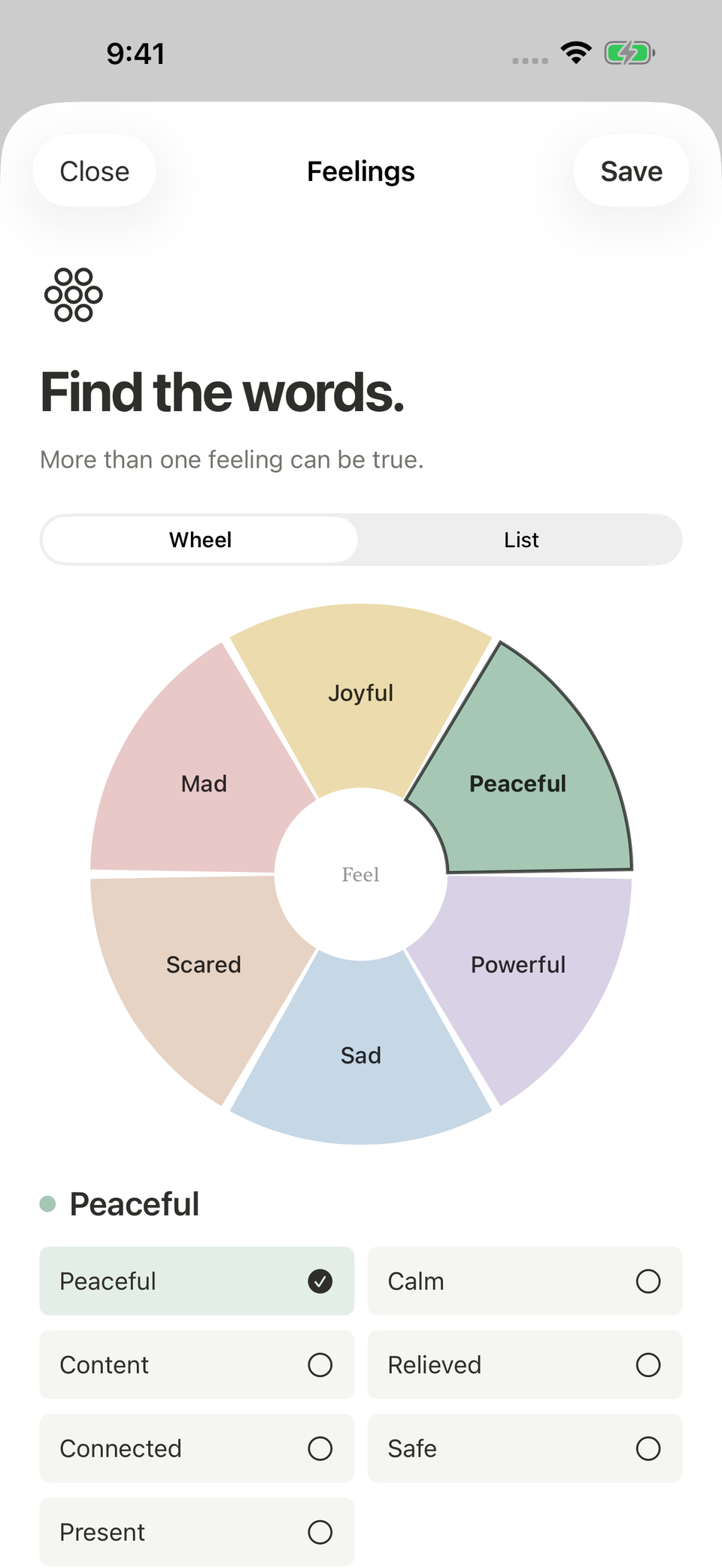
An illustrative Still screen. The words you select can be accompanied by your own context.
Use two short paragraphs instead of one conclusion
Choose a manageable recent event and divide the page into two small paragraphs. In the first, describe one feeling and the part of the event it relates to. In the second, describe another. Do not add a concluding sentence yet.
A hypothetical entry about a friend's move might read: “I feel excited for them because this is something they have wanted for a long time. I liked hearing them talk about the new place.” The second paragraph could say: “I feel lonely when I think about losing our ordinary weekday visits. I do not yet know what our routine will become.”
Now stop and read both. Does either paragraph need to be withdrawn for the other to remain true? Often the answer will be no. If you do want to add a final sentence, it might simply be, “Both parts are here today.” You are not required to turn the entry into a decision about the friendship or a plan for handling the move.
Do not turn a feeling into an accusation against yourself
Mixed feelings can be uncomfortable when you believe one of them makes you a bad friend, partner, colleague, or family member. An entry such as “I am jealous, so I must not care about them” combines a feeling with a broad conclusion about your character.
You can record that thought without treating it as established fact. “I noticed jealousy, and I worried that it meant I was not being supportive” keeps the interpretation visible as an interpretation. You can then describe the situation more specifically: what you wanted for yourself, what you appreciate about the other person, and what you actually chose to do.
The journal does not need to excuse behavior or issue a verdict on your character. Feeling something and deciding how to act are different parts of the experience. Writing can preserve both, including the possibility that your actions reflected care even while the feeling was complicated.
Leave room for words you cannot yet choose
Two labels may still be too simple. You may recognize excitement and worry while sensing another part that you cannot name. You can use ordinary language instead of searching for a more impressive emotional term.
Try a description such as, “There is a part of this that feels unfamiliar,” or “I keep returning to the way the conversation ended.” These sentences can belong beside selected feeling words. They are not lesser observations just because they do not fit neatly into a vocabulary list.
If you use a feeling wheel, treat it as a source of possibilities. A word may suggest a direction to explore, but it does not prove that the word describes you. You can decline every option, change a selection, or return to the entry later. The point is to find language that serves the experience, not to make the experience fit a diagram.
Decide what you want to revisit
When saving an entry about mixed emotions, include a small amount of identifying context. “The message about the move” or “After the conversation about next month” may be enough to distinguish it from other records. Your future self may remember the event more readily than the exact combination of labels.
Later, you can reread the entry for its separate concerns. Perhaps the excitement remains while the worry has changed. Perhaps new information has altered how you understand the event. You can add a note without replacing the earlier account. A changing feeling does not mean the old record was a mistake.
You can also choose not to review it. Some entries are useful because you made room for the words at the time. Revisiting every emotional moment is not a requirement for keeping a journal, and a private record does not need to produce an insight on demand.
Keep the format as small as you need
In Still, a feeling check-in can hold several words with a short note. A journal page gives you space for separate paragraphs or a sequence of events. Use whichever format fits the amount you want to save today.
A short version of the exercise is enough: “I feel ___ about . I also feel ___ about .” You can replace the blanks with your own sentences if that sounds less artificial. You can stop after one line if the second feeling is not clear.
The aim is an account that leaves the experience intact. You do not need to choose a winner, force a positive ending, or prove that the feelings fit together. Sometimes the most accurate thing you can write is that more than one thing mattered at once.