An emotion journal can be pleasant to fill in and still be difficult to use a week later. If looking back is part of your reason for keeping one, evaluate the saved record as carefully as the check-in screen. You need to recognize what happened, understand what a label represented, and distinguish a missing entry from a day you deliberately described.
Still combines feeling check-ins, mood views, and journal writing. Its seven-day and thirty-day views can provide a way into your recent records, while your notes and pages hold the context you chose to save. The buying question is whether that combination helps you return to your own experiences in a useful way, without asking a chart to explain more than it can.
Begin with the question you expect to ask later
“I want to see my emotions over time” sounds clear until you try to use the record. Do you want to remember why a certain day felt difficult? Find an entry about a conversation? Notice which experiences you described as hopeful? These are different retrieval tasks.
Choose one before comparing apps. For example: “At the end of the week, I want to remember what was happening on the days I felt frustrated.” That question requires some context alongside the feeling label. A row of identical words may not be enough once the events are no longer fresh.
Another person might simply want a quick overview of the daily moods they recorded, without returning to individual stories. That is a legitimate preference too. The useful app is the one that supports the kind of review you actually want, not the one with the most elaborate display of information you will rarely consult.
Save enough context for the future version of you
A check-in note can be brief and still make a large difference to recognition. “Disappointed after the call about the weekend” tells you more than “disappointed again.” It points to an event without requiring a detailed account of every part of the conversation.
You can add what mattered to you if that is useful: “I had been looking forward to having an unhurried afternoon together.” This keeps the emotional record connected to your expectation. It does not establish anyone else's motive or require the entry to end with a solution.
When testing an app, create two check-ins that use the same feeling word but concern different situations. Then return to them after doing something else. Can you tell which is which without reconstructing the entire day from memory? If not, the notes you can save or the way they are presented may deserve more attention than the overview chart.
Understand what a pattern is made from
A history shows the records you entered. It does not contain every feeling you had between check-ins. It also reflects when you were inclined to open the app and which words you tended to choose. That context matters when you interpret a repeated label.
Suppose you recorded frustration on three workdays. Several explanations remain possible. The same situation may have recurred. Different events may have led you to use the same word. You may have been more likely to document frustration than contentment. The records alone do not establish which explanation is correct.
Use the overview to form a question you can explore in the entries: “What was similar about these moments?” That is a more grounded use than treating the display as proof that a certain person, activity, or day of the week caused the feeling. A personal journal can support curiosity while leaving uncertainty visible.
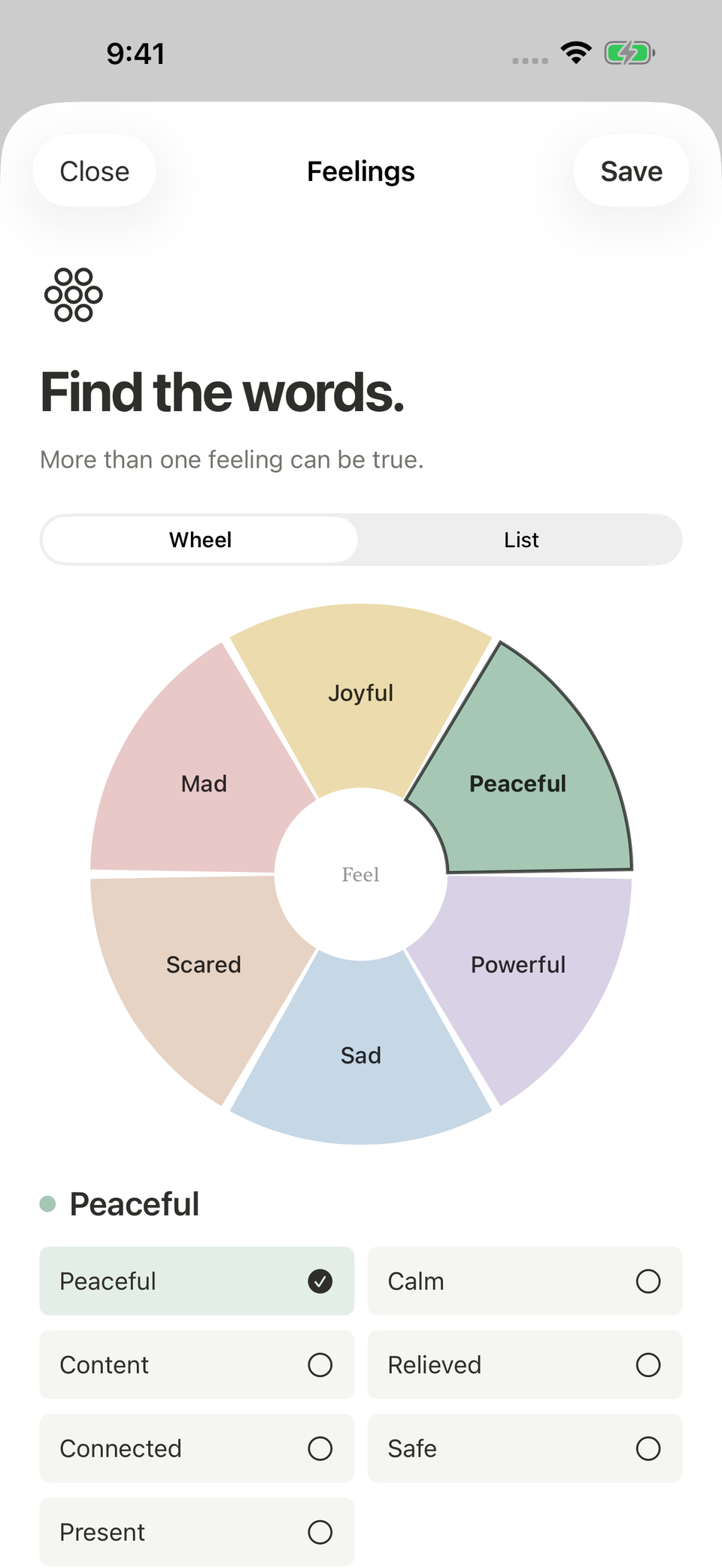
An illustrative Still screen. Your history reflects the records you choose to make, not a continuous measurement of your emotional life.
Compare an overview with the individual record
Still's mood and feeling features include seven-day and thirty-day views. These offer different spans for looking back at recent check-ins. A shorter view may make individual days easier to place. A longer view may prompt different questions because you have more records in front of you.
Neither span is inherently more meaningful. The amount of detail you entered, the events involved, and the question you are asking all affect what you can learn from a review. A sparse month does not become a complete account because it occupies a month-shaped chart.
During an evaluation, move from the overview to the saved context. Check whether the app lets you return to the words you used and whether you can edit or delete your own records. An overview is most useful when it remains connected to the underlying entries rather than becoming a separate score you feel obliged to improve.
Keep missing days separate from neutral days
There are many ordinary reasons not to record a check-in. You may have been busy, uninterested in documenting the day, away from your phone, or simply doing something else. A blank day does not tell you which reason applies.
When choosing an emotion journal, look at how unrecorded days appear. You should be able to distinguish the absence of a record from an entry that says the day felt ordinary or neutral. Otherwise, it becomes easy to read information into a gap that was never supplied.
The same principle applies when you write about a missing stretch later. You can add what you remember without pretending that it is a complete reconstruction. “I did not make entries that week; I remember the trip feeling busy” is more precise than assigning a confident emotional account to each day after the fact.
Test the longer writing as well as the labels
Some experiences need more space than a check-in note. You may want to record how a conversation unfolded, why an event connected with something earlier, or how your interpretation changed. If that is part of the history you want, look at the journal editor and retrieval tools alongside the feeling feature.
Still provides journal writing as a separate way to preserve that fuller account. You can use a clear opening sentence to identify the event and write as much context as you want to keep. Do not assume the app automatically analyzes the relationship between a page and a feeling record just because both are available.
Try finding an older page during your evaluation. A journal that is easy to write in but awkward to search or reread may not suit someone who mainly wants a long-term archive. Conversely, if you rarely look back, you may reasonably prioritize the creation experience and a straightforward way to preserve your files.
Include preservation in the comparison
A useful history is also one you understand how to keep. Still stores journal and check-in content locally without a Still account, account-based cloud sync, or an automatic Still server backup. That means backing up is a deliberate part of preserving the record.
Read the backup instructions before you make the app your main archive. A Still backup and a readable journal export are not interchangeable. The backup holds supported app records for restoration; readable journal exports are for selected journal pages. Separate feeling notes should not be assumed to appear in a journal document export.
Also check what remains accessible if you stop subscribing. In Still, check-ins and access to existing writing remain available without an active subscription, with the documented controls for editing, deleting, backing up, and exporting existing entries. Current plan details are on the support page and the Apple purchase screen.
Choose a history you can read without turning it into a verdict
Before deciding, save a few ordinary records and revisit them with one question. Try “What was I hoping for in these entries?” or “Which details help me remember the event?” Notice whether the app brings you back to your own words or leaves you mainly reacting to a visual summary.
If Still's combination of brief check-ins, recent views, and longer pages fits that approach, explore the current app. If you need a different kind of archive or continuity across devices, include those requirements in your choice.
Your emotional history is a set of descriptions made at particular moments. It can be useful without being complete, and it can change as you add context. The right tool should help you return to those descriptions without turning them into a fixed judgment about the kind of person you are.